What Is Machine Learning? | Types of Machine Learning Algorithms
Introduction
What Is Machine Learning? It is a branch of artificial intelligence that enables computers to learn patterns from data and make predictions.
Moreover, these systems can support recommendations, fraud detection, image recognition, and forecasting. For students and fresh graduates in Chennai, learning these concepts can create a strong foundation for data-focused careers.
Machine learning does not require a computer to receive instructions for every possible situation. Instead, a model learns from examples and applies those patterns to new information.
For example, an online store can study customer behavior and recommend relevant products. Similarly, a bank can analyze transactions to identify unusual activity.
Table of Contents
- What Is Machine Learning?
- How Does Machine Learning Work?
- Why Learn Machine Learning?
- What Are the Types of Machine Learning?
- Supervised Learning
- Unsupervised Learning
- Reinforcement Learning
- What Are the Key Machine Learning Algorithms?
- Practical Tools for Machine Learning
- Real-World Applications
- Career Opportunities in Machine Learning
- Self-Learning vs. Hands-on Training
- Frequently Asked Questions About Machine Learning
- Conclusion
What Is Machine Learning?
Machine learning allows computers to identify patterns from data and use them for predictions or decisions.
First, developers collect relevant information for a specific problem. Next, they clean the dataset and prepare suitable features.
The model then learns relationships from the training data. Afterward, developers evaluate its performance using separate data.
For instance, a house-price model can learn from property size, location, rooms, and previous prices. As a result, it can estimate prices for new properties.
How Does Machine Learning Work?
A machine learning workflow usually includes data preparation, training, testing, and evaluation.
Initially, developers identify the problem and collect useful information. Then, they remove errors, handle missing values, and prepare the dataset.
After that, an algorithm learns from the prepared data. Finally, developers evaluate the model and improve it when necessary.
The process can vary depending on the project. However, the basic goal remains the same: use data to produce useful results.
Why Learn Machine Learning?
Machine learning skills can help learners understand how data supports predictions and business decisions.
Moreover, organizations use these techniques across finance, healthcare, retail, marketing, manufacturing, and software development. Therefore, learners can explore several technology career paths.
Students can begin with Python, SQL, statistics, and basic mathematics. In addition, practical projects can make technical concepts easier to understand.
A structured Data Science Training in Chennai program can provide a guided learning path. As a result, students can progress from programming fundamentals to data analysis and predictive modeling.
What Are the Types of Machine Learning?
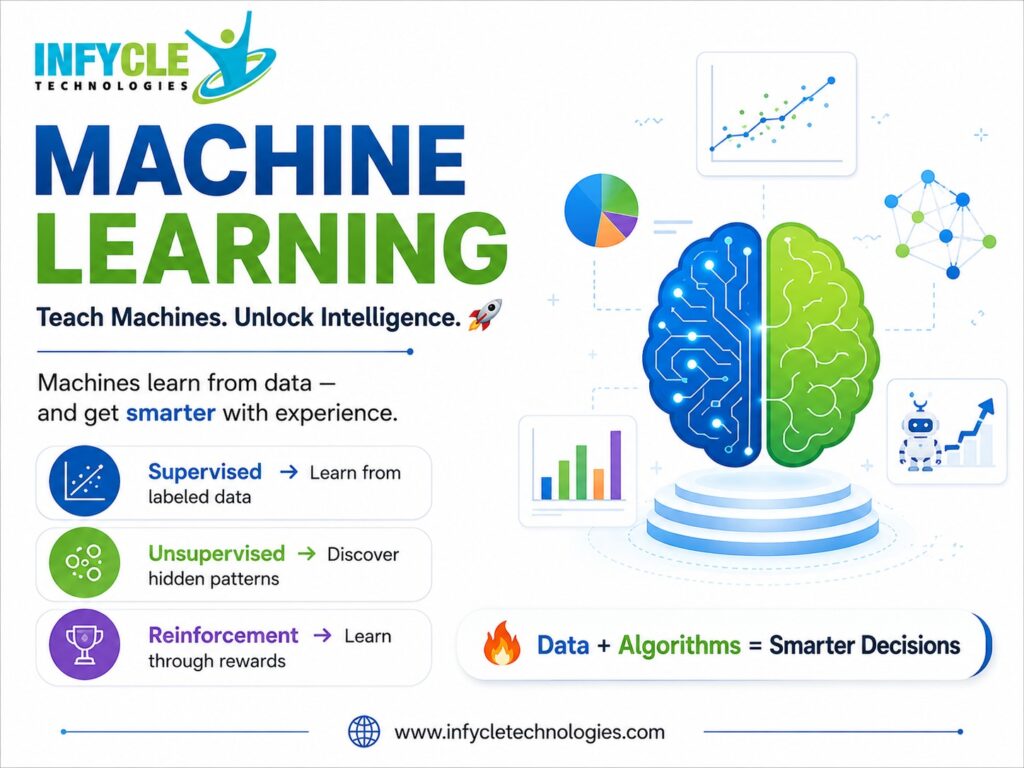
The three major learning approaches are supervised learning, unsupervised learning, and reinforcement learning.
Each approach handles data differently. Therefore, choosing the right method depends on the problem, dataset, and expected result.
Supervised Learning
Supervised learning uses labeled data to train a model.
For example, a dataset may contain house features along with actual selling prices. The model learns from these examples and predicts prices for new houses.
Classification and regression are the two common supervised learning tasks.
Classification predicts categories such as spam or legitimate email. In contrast, regression predicts numerical values such as revenue, temperature, or property prices.
Common algorithms include:
- Linear Regression
- Logistic Regression
- Decision Tree
- Random Forest
- Support Vector Machine
- K-Nearest Neighbors
Unsupervised Learning
Unsupervised learning finds patterns in data without predefined target labels.
For instance, a retailer can group customers according to their purchasing behavior. Consequently, marketing teams can create more relevant customer segments.
Popular techniques include:
- K-Means Clustering
- Hierarchical Clustering
- DBSCAN
- Principal Component Analysis
Therefore, this approach is useful when the hidden structure of a dataset is not already known.
Reinforcement Learning
Reinforcement learning trains an agent through rewards and penalties.
For example, an agent can learn a game strategy by receiving rewards for successful actions. Over time, it can improve decisions through repeated interaction.
This approach is useful in robotics, gaming, optimization, and autonomous systems. However, beginners usually study it after understanding basic predictive models.
What Are the Key Machine Learning Algorithms?
Different algorithms solve different types of prediction, classification, and grouping problems.
Moreover, no single method works best for every dataset. Therefore, developers consider data size, features, target variables, performance, and interpretability before selecting an algorithm.
Linear Regression
Linear Regression predicts a numerical value using relationships between variables.
For example, a business can estimate sales based on advertising expenditure. Furthermore, this method is simple and useful for learning predictive modeling fundamentals.
Logistic Regression
Logistic Regression is commonly used for classification tasks.
For instance, a company can predict whether a customer may leave a service. The model produces a probability that helps classify the result.
Decision Tree
A decision tree makes predictions through a sequence of decision rules.
For example, a financial organization can classify loan applications using customer information. In addition, the tree structure makes its decisions easier to explain.
Random Forest
Random Forest combines multiple decision trees to improve prediction performance.
As a result, it can handle many classification and regression tasks. It is also useful as a strong starting model for structured datasets.
K-Means Clustering
K-Means groups similar data points into a selected number of clusters.
For example, businesses can group customers according to spending behavior. Therefore, marketing teams can design campaigns for different customer segments.
Practical Tools for Machine Learning
Practical learning combines programming, data processing, visualization, and modeling tools.
First, Python provides the main programming foundation. Next, NumPy supports numerical calculations, while Pandas helps manage structured datasets.
Matplotlib and Seaborn support data visualization. Furthermore, Scikit-learn provides algorithms, preprocessing tools, and model evaluation functions.
| Tool | Main Purpose |
|---|---|
| Python | Programming |
| NumPy | Numerical computing |
| Pandas | Data manipulation |
| Matplotlib | Visualization |
| Seaborn | Statistical charts |
| Scikit-learn | Model development |
| Jupyter Notebook | Interactive coding |
| SQL | Database querying |
A strong Data Science Course in Chennai should connect these tools through practical exercises. Consequently, learners can understand how raw data becomes useful information.
Real-World Applications of Machine Learning
Machine learning supports many practical applications across different industries.
For example, streaming platforms can recommend movies based on viewing behavior. Similarly, email services can classify unwanted messages.
Furthermore, financial organizations use models for fraud detection and risk analysis. Healthcare teams can also use predictive systems for selected research and diagnostic support tasks.
Common applications include:
- Recommendation systems
- Fraud detection
- Customer segmentation
- Sales forecasting
- Predictive maintenance
- Sentiment analysis
- Image classification
- Speech recognition
However, these systems still require human oversight. Data quality, accuracy, fairness, privacy, and business context must receive careful attention.
Career Opportunities in Machine Learning
Machine learning knowledge can support careers in data science, analytics, artificial intelligence, and software development.
Moreover, learners can improve their career options by combining Python with SQL, statistics, visualization, and model-building skills.
Potential roles include:
- Data Scientist
- Machine Learning Engineer
- Data Analyst
- AI Engineer
- Business Intelligence Analyst
- Python Developer
- Junior Data Science Associate
Practical projects can also strengthen a learner’s portfolio. For example, candidates can build a house-price predictor, customer segmentation model, or spam classifier.
As a result, projects can demonstrate skills in data preparation, model training, evaluation, and presentation.
Self-Learning vs. Hands-on Training at Infycle Technologies
Both approaches can help learners develop technical knowledge, but hands-on training offers structured practice and direct guidance.
| Learning Area | Self-Learning | Hands-on Training at Infycle Technologies |
| Python fundamentals | Self-paced | Guided sessions |
| ML concepts | Online resources | Trainer explanation |
| Dataset practice | Self-managed | Practical exercises |
| Project development | Independent | Structured projects |
| Doubt clarification | Delayed | Direct support |
| Career guidance | Limited | Training-focused |
Self-learning provides flexibility and access to many resources. However, guided practice can help beginners understand difficult concepts and correct mistakes faster.
Ready to understand What Is Machine Learning through practical examples and projects?
Infycle Technologies provides structured data science training in Chennai for learners who want practical technology skills. Moreover, students can practice Python, SQL, data analysis, algorithms, and project development.
You can also discuss your career goals before selecting a suitable learning path.
Frequently Asked Questions About Machine Learning
What Is Machine Learning?
What Is Machine Learning? It is a technology that enables computers to learn patterns from data and produce predictions or decisions.
What are the three main types?
The three major approaches are supervised learning, unsupervised learning, and reinforcement learning. Each method suits different data and business problems.
Which programming language is popular for machine learning?
Python is one of the most popular choices for machine learning. Moreover, libraries such as Pandas, NumPy, and Scikit-learn simplify development.
Is machine learning suitable for beginners?
Yes, beginners can start with Python, statistics, SQL, and basic modeling concepts. Then, they can progress toward algorithms and real-world projects.
Conclusion
Machine learning helps computers identify useful patterns and produce predictions from data.
Therefore, understanding supervised, unsupervised, and reinforcement learning provides a strong foundation for further study. Moreover, algorithms such as Linear Regression, Decision Trees, Random Forest, and K-Means have practical uses across many industries.
For students and job seekers, Data Science Training in Chennai can provide structured learning and project exposure. When selecting the best software training institute in Chennai, consider practical sessions, trainer support, projects, curriculum quality, and career guidance.
Final CTA
Ready to build your career in data science?
Connect with Infycle Technologies Chennai for free career counselling and a live demo. Get guidance on the right learning path and discover practical training options for your career goals.