How Is AI in Azure DevOps Shaping the Future of Cloud Automation?
Introduction
This is why AI in Azure DevOps has become an important topic for students, IT professionals, and businesses looking to stay ahead in cloud engineering. Rather than replacing DevOps engineers, AI is enhancing their productivity by automating routine processes, improving deployment quality, and reducing manual effort.
For learners in Chennai, understanding this shift is becoming increasingly valuable. Whether you’re an engineering graduate, a student from a non-technical background, or someone planning a career transition, learning how AI integrates with Azure DevOps can help you build skills that align with current industry expectations. This article explores how AI is reshaping cloud automation, the skills employers are looking for, and why the future of DevOps is becoming more intelligent than ever before.
Why AI and Azure DevOps Are a Powerful Combination
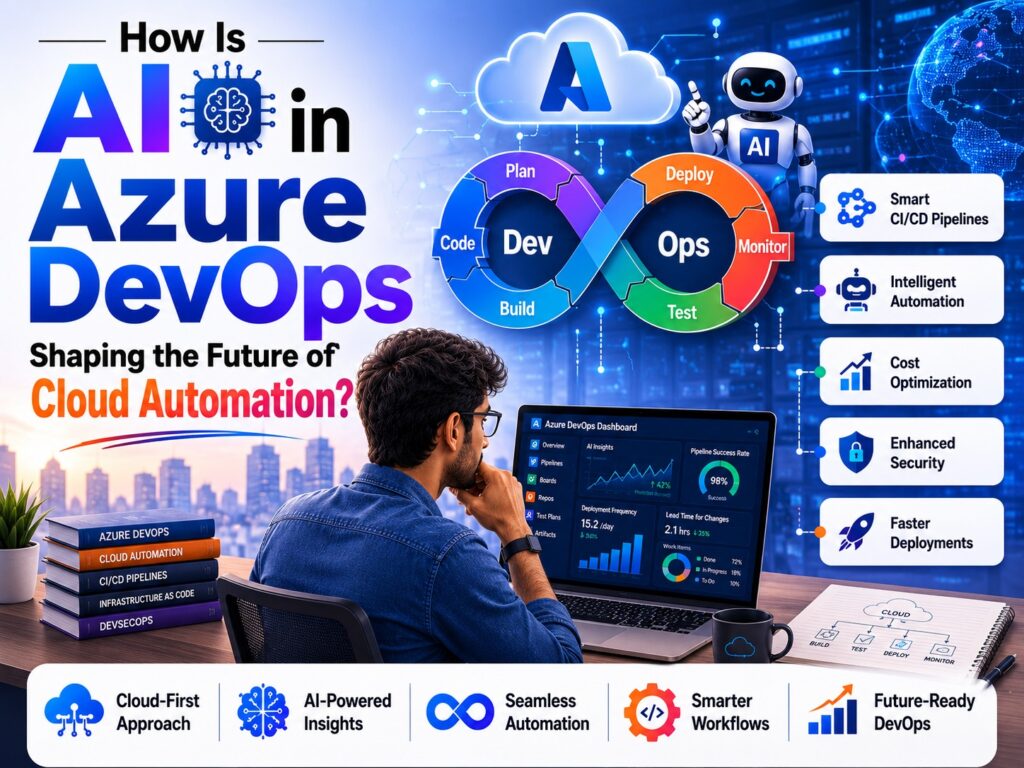
Azure DevOps already provides a complete platform for planning, developing, testing, deploying, and monitoring software.
By adding Artificial Intelligence into these workflows, development teams can:
- Detect software defects earlier
- Predict deployment failures
- Improve code quality
- Automate testing
- Strengthen security
- Monitor cloud resources intelligently
- Reduce deployment downtime
Instead of spending hours identifying issues manually, engineers can use AI-powered insights to focus on solving business problems and building better software.
How AI in Azure DevOps Is Transforming Modern Cloud Automation
Cloud automation has traditionally focused on reducing manual work.
Today, AI takes automation one step further by making systems capable of learning from historical data and recommending improvements automatically.
Some of the biggest transformations include:
Intelligent CI/CD Pipelines
Continuous Integration and Continuous Deployment (CI/CD) pipelines are essential parts of DevOps.
AI helps by:
- Predicting failed builds
- Identifying risky code changes
- Prioritizing testing
- Detecting deployment anomalies
- Recommending pipeline improvements
As software projects become larger, these intelligent capabilities save significant development time.
Smarter Infrastructure Monitoring
Monitoring cloud infrastructure used to depend heavily on manual dashboards and alerts.
AI-powered monitoring tools can now:
- Detect unusual server behavior
- Predict resource shortages
- Identify abnormal traffic patterns
- Recommend infrastructure optimization
- Reduce unexpected downtime
Instead of reacting after problems occur, DevOps teams can address issues proactively.
AI-Assisted Code Reviews
Modern development teams often review thousands of lines of code.
AI tools can assist by:
- Detecting duplicate code
- Identifying security vulnerabilities
- Suggesting performance improvements
- Finding syntax inconsistencies
- Recommending coding best practices
These suggestions help developers maintain consistent code quality while reducing review time.
Why Students Should Learn AI in Azure DevOps
Many students believe DevOps is only about cloud servers and deployment tools.
The reality is much broader.
Today’s DevOps engineers are expected to understand automation, cloud services, scripting, monitoring, collaboration, security, and increasingly, AI-powered workflows.
Learning these concepts helps students understand how modern software delivery actually works inside organizations.
For beginners, this means developing practical knowledge rather than simply memorizing tools.
Skills That Complement Azure DevOps
Students preparing for DevOps careers should gradually build knowledge in:
- Microsoft Azure
- Git & GitHub
- Azure Repos
- Azure Pipelines
- Docker
- Kubernetes
- Terraform
- Linux Administration
- PowerShell
- YAML
- Monitoring Tools
- Cloud Security
- AI-assisted automation
These technologies work together to create scalable cloud environments used by enterprises worldwide.
Industry Trends Shaping DevOps in 2026
Technology adoption continues to accelerate across industries.
Several trends are influencing Azure DevOps careers.
AI-Powered Predictive Operations
Instead of simply monitoring systems, AI predicts failures before they happen.
This helps organizations reduce outages and improve application availability.
Security Automation (DevSecOps)
Security is becoming part of every development stage.
AI assists security teams by:
- Detecting vulnerabilities
- Monitoring suspicious activity
- Automating compliance checks
- Reducing false alerts
This shift makes DevSecOps one of the fastest-growing areas within cloud engineering.
Infrastructure as Code
Managing cloud infrastructure through code has become standard practice.
Combined with AI, Infrastructure as Code enables:
- Faster deployments
- Consistent environments
- Reduced manual configuration
- Better scalability
This approach is widely used across enterprise cloud environments.
If you’re exploring cloud technologies, don’t focus only on learning individual tools. Understanding how Azure services, DevOps practices, automation, and AI work together will help you build stronger technical foundations and prepare for evolving cloud engineering roles.
Real-World Example: AI Improving Software Delivery
Imagine an e-commerce company preparing for a large seasonal sale.
The development team deploys software updates several times every week.
Without AI:
- Engineers manually review logs.
- Performance issues may go unnoticed.
- Failed deployments require lengthy investigations.
With AI integrated into Azure DevOps:
- Build failures are predicted.
- Security risks are identified automatically.
- Performance bottlenecks are detected early.
- Infrastructure scaling recommendations are generated before traffic spikes.
This reduces downtime while improving customer experience.
The Future of AI in Azure DevOps: What Should Students Expect?
The demand for cloud professionals continues to grow as businesses modernize their applications and infrastructure. At the same time, Artificial Intelligence is becoming a practical tool that helps organizations build software faster, improve security, and optimize cloud operations.
This doesn’t mean DevOps engineers are becoming less important. Instead, their responsibilities are evolving.
Modern DevOps professionals are increasingly expected to:
- Work with AI-assisted development tools
- Manage cloud-native applications
- Improve deployment reliability
- Automate infrastructure management
- Monitor application performance
- Strengthen cloud security
- Collaborate across development and operations teams
Students who understand these technologies today will be better prepared for tomorrow’s cloud engineering roles.
AI in Azure DevOps Is Creating New Career Opportunities
One of the biggest misconceptions is that AI will replace DevOps engineers.
In reality, organizations still require skilled professionals to design cloud architectures, manage deployments, troubleshoot production issues, and make strategic technical decisions.
AI simply reduces repetitive work.
For example:
Instead of manually reviewing thousands of deployment logs, engineers can focus on solving critical business problems while AI highlights unusual patterns and potential risks.
This allows DevOps teams to spend more time on innovation rather than routine maintenance.
Essential Skills for Future Azure DevOps Engineers
If you’re planning a career in cloud automation, developing a combination of technical and analytical skills can make you more industry-ready.
Some valuable skills include:
Cloud Platforms
- Microsoft Azure
- Azure Virtual Machines
- Azure Kubernetes Service
- Azure Storage
- Azure Networking
DevOps Tools
- Azure DevOps
- Git
- GitHub
- Azure Pipelines
- Azure Boards
- Azure Repos
Automation Technologies
- Docker
- Kubernetes
- Terraform
- Ansible
- PowerShell
- YAML
AI & Monitoring
- Azure Monitor
- Application Insights
- Predictive Analytics
- Intelligent Alerting
- AI-assisted Monitoring
Together, these skills provide a strong foundation for cloud engineering and modern software delivery.
Common Myths About AI in Azure DevOps
Technology often creates misconceptions, especially when AI is involved.
Let’s clarify a few common ones.
Myth 1: AI Will Replace DevOps Engineers
Reality:
AI supports engineers by automating repetitive tasks.
Design decisions, cloud architecture, troubleshooting, security planning, and collaboration still depend on human expertise.
Myth 2: Beginners Cannot Learn Azure DevOps
Reality:
Many successful DevOps professionals started with little or no cloud experience.
A structured learning approach that begins with Git, Linux, Azure fundamentals, and automation makes the subject much easier to understand.
Myth 3: Only Developers Need Azure DevOps
Reality:
Cloud engineers, testers, system administrators, release engineers, site reliability engineers, and infrastructure professionals all use DevOps practices in different ways.
How to Start Learning Azure DevOps
If you’re completely new to cloud computing, don’t try to learn everything at once.
A practical roadmap looks like this:
Step 1
Learn basic programming concepts and Linux fundamentals.
Step 2
Understand Git and version control.
Step 3
Learn Microsoft Azure services.
Step 4
Study Azure DevOps components.
Step 5
Practice CI/CD pipelines.
Step 6
Learn Docker and Kubernetes.
Step 7
Explore Infrastructure as Code using Terraform.
Step 8
Understand how AI enhances monitoring, automation, and cloud operations.
Following a structured roadmap helps learners build confidence gradually instead of feeling overwhelmed.
If you’re researching cloud technologies, focus on building practical skills through hands-on projects rather than learning tools in isolation. Working with Azure services, CI/CD pipelines, containers, and automation can provide valuable real-world experience and help you understand how modern cloud environments operate.
Why Practical Learning Matters More Than Theory
Reading documentation helps build knowledge.
Building cloud solutions develops confidence.
Students who create real projects often gain a deeper understanding of:
- Deploying web applications
- Configuring Azure Pipelines
- Managing source code
- Automating deployments
- Monitoring application health
- Solving deployment failures
These practical experiences are often discussed during technical interviews because they demonstrate problem-solving ability.
For learners in Chennai, choosing a learning environment that encourages experimentation and project-based learning can make a significant difference when preparing for cloud engineering roles.
Frequently Asked Questions
1. Is AI in Azure DevOps replacing DevOps engineers?
No. AI automates repetitive tasks such as monitoring, testing, and deployment analysis, but engineers are still responsible for architecture, security, troubleshooting, and decision-making.
2. Can beginners learn Azure DevOps without cloud experience?
Yes. Beginners can start with Azure fundamentals, Git, Linux, and basic automation before moving to advanced DevOps concepts. A structured learning path makes the transition much easier.
3. Which industries use Azure DevOps?
Azure DevOps is widely used in software development, banking, healthcare, e-commerce, manufacturing, education, telecommunications, and enterprise IT organizations that rely on cloud-based application development.
4. Which skills should students focus on for future DevOps careers?
Students should develop skills in Azure, Git, Docker, Kubernetes, Terraform, CI/CD pipelines, cloud security, scripting, monitoring tools, and AI-assisted automation to stay aligned with evolving industry requirements.
Conclusion
Artificial Intelligence is reshaping how cloud platforms are managed, but it is enhancing—not replacing—the role of DevOps professionals. As organizations continue to adopt cloud-native technologies, the ability to combine automation, infrastructure management, and intelligent monitoring will become increasingly valuable. Building practical expertise through Azure DevOps Training in Chennai can help learners understand modern cloud workflows, prepare for evolving industry expectations, and develop skills that remain relevant as technology advances.