Top 20 Data Science Interview Questions And Answers For Freshers (2026)
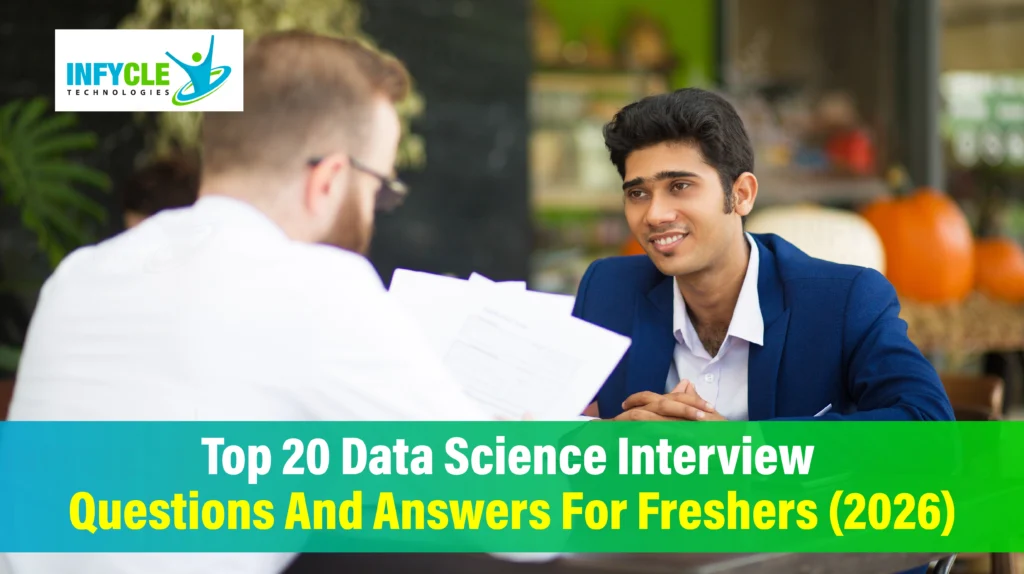
Data Science Interview Questions and Answers for Freshers are essential as Data Science continues to be one of the most in-demand career paths in 2026. With companies relying heavily on data-driven decision-making, freshers who enter the job market with strong data science fundamentals gain a clear advantage. However, cracking a data science interview requires more than just theoretical knowledge—it demands clarity, practical understanding, and confidence.
This blog covers the Top 20 Data Science Interview Questions and Answers for Freshers (2026), designed to help beginners prepare effectively. Whether you are a student, career switcher, or recent graduate, these questions reflect what recruiters commonly ask in real interviews.
In the early stages of preparation, many freshers choose structured learning through Data Science Training In Chennai, as it provides hands-on exposure, real-time projects, and interview-focused guidance. With the right training and consistent practice, clearing interviews becomes much more achievable.
Why Data Science Interview Preparation Matters For Freshers In 2026
Understanding What Interviewers Really Look For
In 2026, data science interviews are no longer limited to basic definitions or textbook answers. Interviewers expect freshers to demonstrate clear thinking, problem-solving ability, and a basic understanding of how data science is applied in real business scenarios. They often test how candidates approach data cleaning, interpret insights, and explain results in simple terms. This makes conceptual clarity just as important as technical knowledge.
Balancing Theory With Practical Knowledge
Many freshers struggle because they focus only on theory without enough practical exposure. While academic learning helps build a foundation, interviews demand hands-on understanding. Recruiters frequently ask scenario-based questions to evaluate how candidates handle real datasets, choose algorithms, and justify their decisions. Practicing projects and case studies helps bridge this gap and builds confidence during interviews.
Preparing For Real-World Data Science Roles
A structured interview preparation approach helps freshers understand industry expectations early in their careers. Learning how data science teams work, understanding business problems, and gaining exposure to real-time tools makes candidates more job-ready. Consistent practice, mock interviews, and learning from feedback play a major role in improving performance and standing out in competitive interview processes.
Data Science Interview Questions For Freshers:
The following are some common questions an interviewer might ask a fresher about Data Science:
1. What Is Data Science?
Data Science is the process of extracting meaningful insights from structured and unstructured data using statistical methods, programming, and machine learning techniques. It combines mathematics, domain knowledge, and computer science to solve real-world problems such as prediction, classification, and recommendation.
2. What Are The key components Of Data Science?
The main components of Data Science include:
- Data collection
- Data cleaning and preprocessing
- Exploratory Data Analysis (EDA)
- Feature engineering
- Model building
- Model evaluation
- Deployment and monitoring
Each stage plays a crucial role in delivering accurate and reliable insights.
3. What Is The difference between Data Science And Data Analytics?
Data Analytics focuses on analyzing historical data to identify trends and patterns, whereas Data Science goes a step further by building predictive and prescriptive models using machine learning and AI techniques.
4. What Programming Languages Are Commonly Used In Data Science?
The most popular programming languages in Data Science are:
- Python
- R
- SQL
- Scala (for big data)
Python is widely preferred due to its rich libraries like NumPy, Pandas, Matplotlib, Scikit-learn, and TensorFlow.
5. What Is Exploratory Data Analysis (Eda)?
EDA is the process of analyzing datasets visually and statistically to understand patterns, detect anomalies, and check assumptions. It includes summary statistics, visualizations, and correlation analysis.
6. What Is The Difference Between Structured And Unstructured Data?
Structured data is organized in rows and columns (e.g., databases, spreadsheets).
Unstructured data includes text, images, audio, and video that do not follow a predefined format.
7. What Is Machine Learning?
Machine Learning is a subset of Artificial Intelligence that allows systems to learn from data and improve performance without being explicitly programmed. It is widely used in prediction, recommendation systems, and automation.
8. What Are The Types Of Machine Learning?
There are three main types:
- Supervised Learning – Uses labeled data
- Unsupervised Learning – Uses unlabeled data
- Reinforcement Learning – Learns through rewards and penalties
9. What Is Overfitting And Underfitting?
Overfitting occurs when a model performs well on training data but poorly on new data.
Underfitting happens when a model fails to capture the underlying pattern of the data.
Balancing model complexity is key to avoiding both.
10. What Is Feature Engineering?
Feature engineering is the process of selecting, transforming, or creating new features from raw data to improve model performance. Good features often matter more than complex algorithms.
11. What Is Normalization And Standardization?
Normalization scales data between 0 and 1.
Standardization transforms data to have a mean of 0 and a standard deviation of 1.
Both techniques help improve model accuracy and convergence.
12. What Are Missing Values, And How Do You Handle Them?
Missing values occur when data points are absent. They can be handled by:
- Removing rows or columns
- Filling with mean, median, or mode
- Using predictive models for imputation
13. What Is A Confusion Matrix?
A confusion matrix is a table used to evaluate classification models. It shows:
- True Positives
- True Negatives
- False Positives
- False Negatives
It helps calculate accuracy, precision, recall, and F1-score.
14. What Is The Difference Between Supervised And Unsupervised Learning?
Supervised learning uses labeled output data, while unsupervised learning identifies hidden patterns without predefined labels. Clustering and association are common unsupervised techniques.
15. What Is Cross-Validation?
Cross-validation is a technique used to evaluate model performance by dividing data into multiple subsets. It ensures the model generalizes well to unseen data.
16. What Is Big Data, And How Is It Related To Data Science?
Big Data refers to extremely large datasets that cannot be processed using traditional tools. Data Science uses big data technologies like Hadoop and Spark to analyze and extract insights from such datasets.
For beginners who want to strengthen their fundamentals, learning resources such as Kaggle provide real-world datasets and challenges that improve practical skills.
17. What Is The Role Of Sql In Data Science?
SQL is used to extract, filter, and manipulate data from relational databases. Data scientists rely on SQL to work with large datasets stored in databases before applying analytical models.
18. What Are Common Data Science Tools?
Some commonly used tools include:
- Jupyter Notebook
- Tableau and Power BI
- Apache Spark
- TensorFlow and PyTorch
Tool knowledge complements programming and statistical skills.
19. What Is The Difference Between Classification And Regression?
Classification predicts categorical outcomes (such as spam or not spam), while regression predicts continuous values (such as salary or house price). Choosing the right approach depends on the problem statement.
20. Why Is Data Science A Good Career Choice In 2026?
Data Science offers high demand, competitive salaries, and diverse career opportunities across industries such as healthcare, finance, e-commerce, and AI-driven startups. With data volumes increasing every year, skilled data professionals will continue to be essential.
Bridging The Gap Between Learning And Industry Expectations
Learning from the Best Software Training Institute in Chennai can help bridge the gap between academic knowledge and industry expectations. Practical exposure, real-time projects, and interview-focused preparation allow freshers to understand how theoretical concepts are applied in real-world business environments. In addition, mentorship from industry experts, continuous skill assessments, and hands-on problem-solving sessions build confidence and job readiness, helping candidates perform effectively in technical interviews and workplace scenarios.
Conclusion
Preparing for data science interviews as a fresher may seem challenging, but with the right approach, it becomes manageable. Understanding core concepts, practicing real-world problems, and staying updated with industry trends are key to success.
Institutes like Infycle Technologies play an important role in shaping industry-ready professionals by offering practical training, expert mentorship, and interview preparation support. With consistent effort and the right guidance, freshers can confidently step into rewarding data science careers in 2026 and beyond.