How to Become an SAP Consultant Without Experience: A Beginner’s Guide

Introduction
Starting a career in SAP without previous experience is possible, even if you have recently graduated. Many companies need professionals who understand business processes, enterprise software, and SAP solutions. Therefore, beginners can build a strong foundation through practical learning and consistent preparation.
If you want to Become an SAP Consultant, you do not always need a technical degree or previous IT experience. Instead, you need to understand SAP modules, learn business workflows, and practise real-world scenarios.
Furthermore, choosing the right SAP module can help you build relevant skills for your preferred career path. For example, beginners can explore SAP FICO, SAP MM, SAP SD, SAP ABAP, and SAP S/4HANA.
However, learning SAP requires more than watching tutorials. You must understand how businesses use SAP to manage their daily operations.
For students, fresh graduates, and career changers in Chennai, structured SAP learning can provide a practical starting point. With proper guidance, hands-on practice, and interview preparation, you can work towards becoming an entry-level SAP professional.
Table of Contents
- Can You Become an SAP Consultant Without Experience?
- What Does an SAP Consultant Do?
- Which SAP Module Should Beginners Choose?
- How to Become an SAP Consultant Without Experience?
- How Can Beginners Gain Practical SAP Experience?
- What Skills Are Required to Become an SAP Consultant?
- Self-Learning vs. Structured SAP Training
- How Does SAP Training Help You Become an SAP Consultant?
- What Should You Include in Your SAP Learning Roadmap?
- Frequently Asked Questions
1. Can You Become an SAP Consultant Without Experience?
Yes, you can become an SAP consultant without previous work experience. However, you must develop SAP knowledge, understand business processes, and gain practical exposure.
Many beginners assume that SAP careers require several years of IT experience. However, this is not always true.
Companies also recruit junior professionals, trainees, and entry-level candidates for suitable roles. Nevertheless, employers expect candidates to demonstrate their knowledge and problem-solving abilities.
Here are some backgrounds suitable for starting an SAP career:
- BCA and B.Sc graduates: Can explore technical and functional SAP modules.
- B.Com and BBA graduates: Can consider SAP FICO and other business-related modules.
- Engineering graduates: Can explore SAP ABAP, SAP BASIS, and technical consulting.
- MBA graduates: Can explore business process consulting and functional modules.
- Career changers: Can use their previous industry knowledge to understand SAP business processes.
Therefore, your educational background can influence your module selection. However, your practical skills and willingness to learn matter significantly.
2. What Does an SAP Consultant Do?
An SAP consultant helps businesses implement, configure, maintain, and improve SAP software according to their business requirements.
SAP consultants connect business operations with technology. For instance, a manufacturing company uses SAP to manage inventory, purchasing, production, and financial transactions.
Furthermore, consultants understand client requirements and recommend suitable SAP solutions.
What Are the Main Responsibilities of an SAP Consultant?
An SAP consultant generally performs the following responsibilities:
- Understand business requirements and client expectations.
- Analyse existing business processes.
- Configure relevant SAP modules.
- Support SAP implementation projects.
- Identify and troubleshoot system issues.
- Prepare technical and functional documentation.
- Test business processes and system configurations.
- Train employees to use SAP applications.
Additionally, SAP consultants coordinate with business teams, developers, and project managers.
As a result, communication, analytical thinking, and business knowledge are important alongside technical skills.
3. Which SAP Module Should Beginners Choose?
Beginners should choose an SAP module based on their education, interests, and career goals. Each module focuses on different business operations.
SAP offers multiple modules for managing enterprise activities. Therefore, understanding their purposes helps you make an informed decision.
Popular SAP Modules for Beginners
1. SAP FICO
SAP FICO focuses on financial accounting and controlling. It helps organisations manage financial transactions, reporting, and accounting operations.
- Suitable for: B.Com, BBA, MBA, and finance graduates.
- Career options: SAP FICO Consultant and Finance Support Analyst.
2. SAP MM
SAP MM manages materials, purchasing, inventory, and procurement processes.
- Suitable for: Commerce, management, and engineering graduates.
- Career options: SAP MM Consultant and Procurement Analyst.
3. SAP SD
SAP SD focuses on sales, distribution, order processing, and delivery management.
- Suitable for: Business, commerce, and management graduates.
- Career options: SAP SD Consultant and Sales Operations Analyst.
4. SAP ABAP
SAP ABAP is a programming language used to develop and customise SAP applications.
- Suitable for: BCA, B.Sc Computer Science, and engineering graduates.
- Career options: SAP ABAP Developer and SAP Technical Consultant.
5. SAP BASIS
SAP BASIS focuses on SAP system administration, installation, monitoring, and technical operations.
- Suitable for: Computer science and IT graduates.
- Career options: SAP BASIS Administrator and SAP Technical Support Engineer.
How Do You Select the Right SAP Module?
First, identify your educational background and interests. Next, understand the responsibilities of each module.
For example, finance graduates can start with SAP FICO. Similarly, programming enthusiasts can explore SAP ABAP.
Ultimately, selecting one module and developing strong practical knowledge is better than learning several modules without depth.
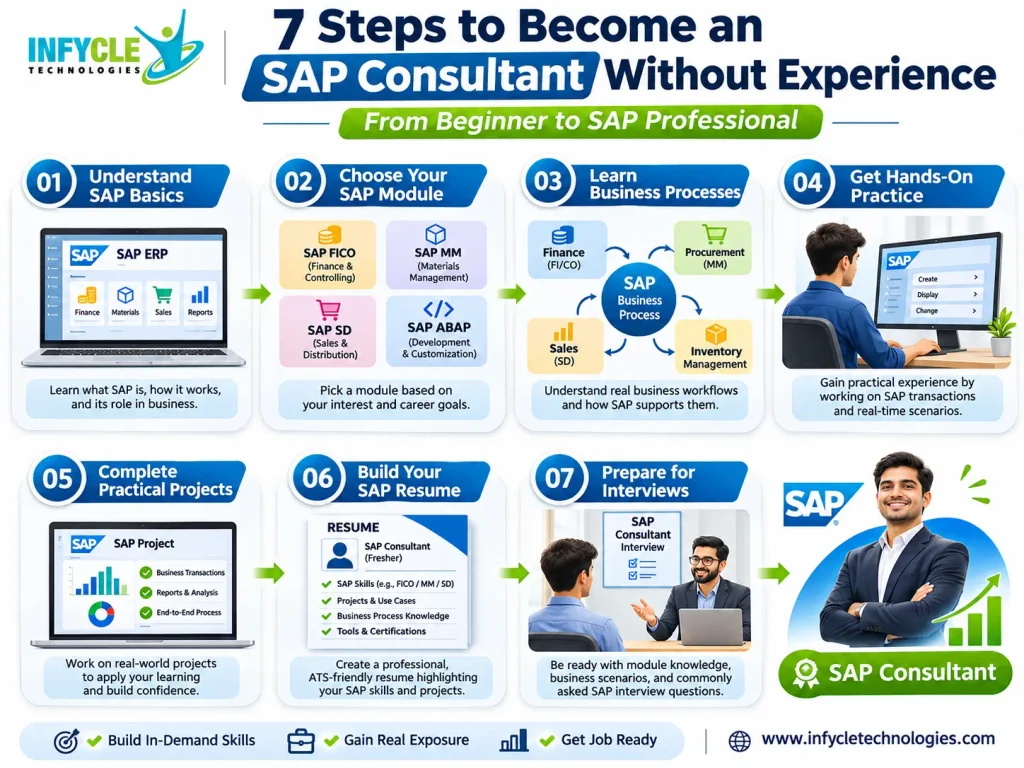
4. How to Become an SAP Consultant Without Experience?
You can become an SAP consultant by following a structured learning path that combines module selection, practical training, business knowledge, and interview preparation.
Here are seven practical steps beginners can follow.
Step 1: Understand the Basics of SAP
First, learn what SAP means and how organisations use enterprise resource planning software.
Understand basic concepts such as:
- Enterprise Resource Planning (ERP).
- SAP architecture and applications.
- Business process management.
- Master data and transaction data.
- SAP modules and their functions.
Furthermore, understand how different departments share information through an integrated ERP system.
Step 2: Choose One SAP Module
Next, select a module that matches your educational background.
For instance, commerce graduates can explore SAP FICO. However, computer science graduates interested in programming can consider SAP ABAP.
Avoid learning multiple modules simultaneously. Instead, build a strong foundation in one module.
Step 3: Learn Business Processes
SAP is closely connected to real business operations. Therefore, understanding business workflows is essential.
For example, SAP MM includes procurement and inventory management.
Similarly, SAP FICO involves financial transactions, accounting, and reporting.
Learn how these processes work before moving into advanced configurations.
Step 4: Get Hands-On SAP Practice
Practical exposure helps you understand how SAP works in real business situations.
Therefore, practise different transactions, configurations, and business scenarios in an authorised SAP learning environment.
For example, SAP FICO learners can practise financial posting scenarios. Likewise, SAP MM learners can explore purchase orders and inventory movements.
Step 5: Work on Practical Projects
Next, complete beginner-friendly projects based on real business situations.
Consider these examples:
- SAP FICO: Create financial accounting scenarios and reports.
- SAP MM: Practise a basic procurement workflow.
- SAP SD: Understand sales order processing and delivery.
- SAP ABAP: Develop simple reports and practise programming concepts.
Moreover, document your learning outcomes. These examples can help you explain your practical knowledge during interviews.
Step 6: Prepare Your SAP Resume
Your resume should highlight your SAP knowledge and practical learning.
Include the following:
- Educational qualifications.
- SAP module and concepts learned.
- Practical exercises and projects.
- Relevant technical skills.
- Training or certification details, if applicable.
- Communication and problem-solving abilities.
However, never claim professional experience if you have only completed training.
Instead, describe your projects honestly and explain your responsibilities clearly.
Step 7: Apply for Entry-Level SAP Opportunities
Finally, start applying for suitable beginner-friendly positions.
Search for opportunities such as:
- SAP Trainee.
- Junior SAP Consultant.
- SAP Functional Support Associate.
- SAP Application Support Analyst.
- SAP End User Support.
- Junior SAP ABAP Developer.
Additionally, prepare for technical interviews and practise explaining business scenarios.
Remember, your first opportunity may involve support or trainee responsibilities. Nevertheless, it can help you develop industry experience.
5. How Can Beginners Gain Practical SAP Experience?
Beginners can gain SAP experience through authorised practice systems, guided projects, training environments, and business process simulations.
Practical learning is important because employers want candidates who understand how SAP works beyond theoretical concepts.
Here are some effective ways to develop practical knowledge.
Explore SAP Learning Resources
First, explore SAP’s official learning resources and available learning journeys.
These resources help beginners understand SAP products, concepts, and technologies.
Practise Real-Time Business Scenarios
Next, connect SAP concepts with actual business activities.
For example, understand how a company purchases materials, receives inventory, processes sales, and records financial transactions.
Complete Module-Based Projects
Furthermore, complete small projects based on your selected module.
Document each project with its objective, process, steps, and outcome.
Learn Through Guided Training
Structured training can help beginners understand complicated configurations and workflows.
In addition, trainers can explain common mistakes and provide guidance during practical exercises.
Mid-Article CTA – Start Your SAP Learning Journey
Are you looking to build an SAP career without previous experience?
Infycle Technologies provides training-oriented learning support for beginners who want to understand SAP concepts and practical business processes.
Explore SAP training opportunities, understand different modules, and take your first step towards developing job-ready skills.
6. What Skills Are Required to Become an SAP Consultant?
An SAP consultant needs SAP module knowledge, business process understanding, analytical thinking, and communication skills.
Although technical knowledge is important, consultants must also understand how businesses operate.
Here are the essential skills beginners should develop.
| Skill | Why Is It Important? |
|---|---|
| SAP Module Knowledge | Helps you understand specific business functions. |
| Business Process Knowledge | Connects SAP operations with business requirements. |
| Analytical Thinking | Helps identify problems and suitable solutions. |
| Communication Skills | Supports interaction with clients and teams. |
| Documentation | Helps maintain project and process records. |
| Problem-Solving | Helps troubleshoot functional and technical issues. |
| Basic Computer Skills | Supports everyday SAP operations. |
Additionally, technical modules may require programming knowledge, database concepts, and system administration skills.
However, functional consultants should focus more on business workflows, module configuration, and requirement analysis.
Therefore, develop skills according to your selected SAP career path.
7. Self-Learning vs. Structured SAP Training: Which Is Better?
Self-learning offers flexibility, while structured SAP training provides guided learning and practical support. Both approaches can help beginners, depending on their learning requirements.
However, beginners sometimes struggle with SAP because the software includes complex business processes and configurations.
Compare both learning methods below.
| Comparison | Self-Learning | Structured SAP Training |
|---|---|---|
| Learning Method | Independent study | Trainer-guided sessions |
| Learning Schedule | Flexible | Planned sessions |
| Doubt Clarification | Requires independent research | Trainer support |
| Practical Exposure | Depends on available resources | Depends on the training environment |
| Learning Path | Self-planned | Structured curriculum |
| Project Guidance | Independent practice | Guided project exercises |
| Interview Preparation | Self-managed | May include interview guidance |
| Suitable For | Self-motivated learners | Beginners seeking guidance |
Which Learning Method Should Beginners Choose?
If you already understand SAP concepts, self-learning may be sufficient for further development.
However, absolute beginners may benefit from structured training because it provides a clear learning path.
Furthermore, trainer guidance can help explain complicated business scenarios.
Ultimately, choose a learning method that provides practical exposure, consistent practice, and a clear understanding of your selected module.
8. How Does SAP Training Help You Become an SAP Consultant?
Quality SAP training helps beginners understand module concepts, practise business processes, and prepare for entry-level opportunities.
However, choosing a suitable training institute is equally important.
If you are searching for SAP Training In Chennai, compare institutes based on their curriculum, practical learning opportunities, trainer expertise, and student support.
What Should You Check Before Joining SAP Training?
Consider these important factors:
1. Industry-Relevant Curriculum
First, check whether the course covers current SAP concepts and relevant business processes.
2. Practical Training
Next, ask whether the institute provides access to an authorised SAP practice environment.
3. Experienced Trainers
Furthermore, understand the trainer’s industry experience and teaching approach.
4. Project-Based Learning
Choose a programme that includes practical exercises and business scenarios.
5. Interview Preparation
Additionally, check whether the training includes resume guidance and interview practice.
6. Course Transparency
Finally, understand the duration, fees, syllabus, learning resources, and placement assistance before enrolling.
Why Consider Infycle Technologies in Chennai?
Infycle Technologies aims to support learners who want to develop practical technology skills and explore professional opportunities.
When evaluating sap course training in chennai, beginners should look for structured learning, practical exposure, and guidance throughout their learning journey.
Additionally, compare institutes carefully before making a decision.
If you are searching for the Best Software Training Institute in Chennai, focus on learning quality rather than advertisements alone.
9. What Should You Include in Your SAP Learning Roadmap?
A practical SAP learning roadmap should cover fundamentals, module knowledge, hands-on exercises, projects, and interview preparation.
Although the learning duration varies, beginners can follow this sample 12-week roadmap.
| Duration | Learning Activities | Expected Outcome |
|---|---|---|
| Weeks 1–2 | SAP fundamentals and ERP concepts | Understand SAP basics |
| Weeks 3–4 | Selected module fundamentals | Understand module functions |
| Weeks 5–6 | Business processes and configurations | Understand workflows |
| Weeks 7–8 | Practical exercises | Develop hands-on knowledge |
| Weeks 9–10 | Module-based projects | Build practical examples |
| Weeks 11–12 | Resume and interview preparation | Prepare for entry-level applications |
However, this is only a suggested learning schedule. Your progress depends on your previous knowledge, module complexity, and practice time.
Furthermore, continue learning even after completing the roadmap.
SAP products and business requirements change. Therefore, regular learning helps you keep your skills relevant.
10. Frequently Asked Questions
1. Can I Become an SAP Consultant Without an IT Background?
Yes, you can become an SAP consultant without an IT background. Functional modules such as SAP FICO, SAP MM, and SAP SD offer learning paths for commerce, management, and other graduates. However, you must understand business processes and develop practical SAP knowledge.
2. How Long Does It Take to Become an SAP Consultant?
The learning duration depends on your selected SAP module, previous knowledge, and practice schedule. Beginners may need several months to develop foundational knowledge and practical skills. However, becoming an independent consultant generally requires additional project exposure and industry experience.
3. Which SAP Module Is Best for Freshers?
The best SAP module depends on your educational background and interests. For example, commerce graduates can explore SAP FICO, while programming enthusiasts can consider SAP ABAP. Similarly, students interested in procurement and inventory can explore SAP MM.
4. Is SAP Certification Mandatory to Become an SAP Consultant?
No, SAP certification is not universally mandatory for every SAP job. However, relevant certification can demonstrate your product knowledge and strengthen your profile. Furthermore, practical skills, module understanding, and relevant project exposure are important when applying for entry-level opportunities.
5. Can I Get an SAP Job After Training?
Yes, completing SAP training can help you prepare for entry-level opportunities. However, training alone does not guarantee employment. You should also develop practical skills, complete relevant projects, prepare your resume, and practise technical interviews.
Conclusion: Start Your Journey to Become an SAP Consultant
You do not need previous professional experience to begin learning SAP. Instead, you need the right learning approach, consistent practice, and a clear career direction.
First, understand SAP fundamentals and select a suitable module. Next, develop business process knowledge and practise real-world scenarios.
Furthermore, complete practical projects and prepare for entry-level interviews. These steps can help you build confidence and demonstrate your knowledge to potential employers.
If you are planning to Become an SAP Consultant, start with one module and focus on developing practical skills.
For students, fresh graduates, and career changers, enrolling in suitable SAP Training In Chennai can provide structured guidance and a foundation for further learning.