Database Administrator Career: Skills, Responsibilities, Salary & Future Scope
Introduction
A Database Administrator Career is a strong option for students and graduates who enjoy databases, SQL, servers, and problem-solving. Moreover, database professionals help organizations store, protect, manage, and recover critical business data.
A Database Administrator, or DBA, manages databases and ensures that applications can access data safely and efficiently. Therefore, DBAs play an important role in IT teams across banking, healthcare, e-commerce, education, and software companies.
For beginners in Chennai, database administration can become a practical entry point into the IT industry. In addition, learning Oracle, SQL, Linux basics, backup methods, and database security can improve job readiness.
However, becoming a DBA requires more than knowing SQL commands. You also need troubleshooting, monitoring, security, backup, and performance skills.
This guide explains the Database Administrator Career, including skills, responsibilities, salary expectations, career paths, and future scope. It also explains how structured Oracle DBA training in Chennai can help beginners build practical skills.
Table of Contents
- What Is a Database Administrator?
- What Does a Database Administrator Do?
- Why Choose a Database Administrator Career?
- What Skills Does a Database Administrator Need?
- What Are the Responsibilities of a DBA?
- Which Database Technologies Should Beginners Learn?
- How Can Oracle DBA Training in Chennai Help?
- What Is the Database Administrator Career Path?
- How Much Does a Database Administrator Earn?
- Self-Learning vs Structured DBA Training
- What Is the Future Scope of a Database Administrator Career?
- Mid-Article CTA
- Frequently Asked Questions
- Conclusion
- Final CTA
What Is a Database Administrator?
A Database Administrator (DBA) manages an organization’s databases, including their performance, security, availability, and recovery. In simple terms, a DBA makes sure that business data remains available, secure, and usable.
For example, an online shopping company stores customer, order, payment, and product information in databases. Therefore, the DBA helps keep this information organized and accessible.
DBAs also work with developers, system administrators, security teams, and business teams. Moreover, they monitor databases and resolve issues before they affect users.
What Does a Database Administrator Do?
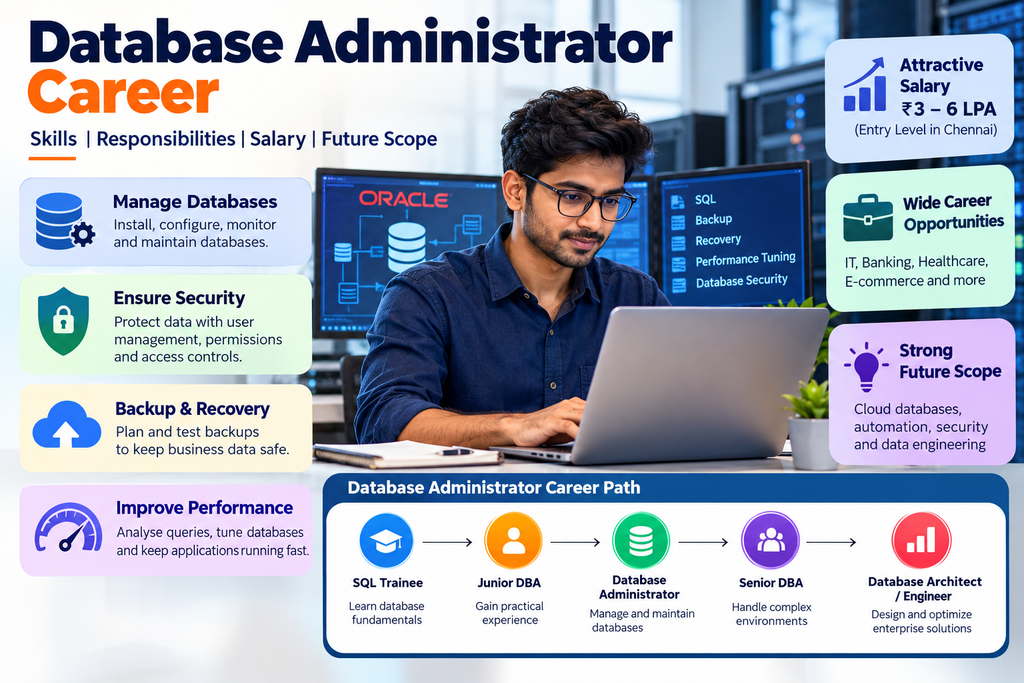
A database administrator manages database systems from setup to maintenance and recovery. Furthermore, the role combines technical knowledge with continuous monitoring and problem-solving.
Typical DBA activities include:
- Installing and configuring databases
- Creating databases and users
- Managing database permissions
- Monitoring database performance
- Taking regular backups
- Restoring data when required
- Troubleshooting database errors
- Managing storage
- Applying patches and updates
- Improving SQL and database performance
- Protecting sensitive information
- Supporting application teams
For instance, if a company’s database becomes slow, the DBA investigates queries, resources, indexes, and database configuration. As a result, the DBA can identify the cause and improve performance.
Why Choose a Database Administrator Career?
A Database Administrator Career offers opportunities across many industries because businesses depend on reliable data systems. Moreover, database skills can lead to several technical career paths.
Is Database Administration Good for Beginners?
Yes, database administration can be suitable for beginners who enjoy logical problem-solving and technical systems. However, beginners should first develop strong SQL and database fundamentals.
A typical learning journey starts with SQL and relational database concepts. Next, learners move toward Oracle administration, Linux, backup, recovery, security, and performance tuning.
Therefore, a structured learning path can make the transition easier for fresh graduates and career changers.
What Industries Hire Database Administrators?
Many industries hire database professionals because they generate and manage large amounts of data.
Common sectors include:
- Banking and finance
- Healthcare
- E-commerce
- IT services
- Telecommunications
- Insurance
- Education
- Government organizations
- Manufacturing
- Logistics
Furthermore, large enterprises often maintain multiple database environments. Consequently, they need professionals who can manage availability, security, and performance.
What Skills Does a Database Administrator Need?
A successful DBA needs database knowledge, troubleshooting ability, security awareness, and strong technical fundamentals. In addition, communication skills help DBAs work effectively with development and infrastructure teams.
Important skills include:
| Skill | Why It Matters |
|---|---|
| SQL | Helps retrieve and manipulate data |
| Oracle | Supports enterprise database administration |
| Database Concepts | Builds strong fundamentals |
| Linux | Helps manage database servers |
| Backup & Recovery | Protects business data |
| Performance Tuning | Improves database speed |
| Security | Protects sensitive information |
| Troubleshooting | Helps resolve database issues |
| Networking Basics | Supports database connectivity |
| Scripting | Helps automate repetitive tasks |
For example, SQL helps you understand queries, while Oracle administration teaches you how the database environment operates.
What Are the Responsibilities of a DBA?
A DBA is responsible for maintaining reliable, secure, and efficient database systems. Therefore, the role includes both routine administration and emergency troubleshooting.
How Does a DBA Manage Database Security?
A DBA protects databases by managing users, roles, permissions, authentication, and access controls. In addition, the DBA follows organizational security policies.
For example, a database administrator may give an employee read-only access instead of full database privileges. Thus, the organization can reduce unnecessary access.
How Does a DBA Handle Backup and Recovery?
A DBA creates and manages backup strategies to protect important business data. Moreover, the DBA tests recovery procedures to ensure backups can actually restore data.
If a system fails, recovery procedures help restore database services. Therefore, backup and recovery knowledge is one of the most important DBA skills.
How Does a DBA Improve Database Performance?
A DBA analyzes slow queries, database resources, indexes, storage, and configuration settings. Furthermore, performance monitoring helps identify bottlenecks.
For instance, an inefficient query can consume significant resources. Consequently, query optimization can improve application response times.
Which Database Technologies Should Beginners Learn?
Beginners should first understand relational databases and SQL before moving into advanced administration. After that, they can specialize in platforms such as Oracle, Microsoft SQL Server, or PostgreSQL.
A useful learning sequence is:
SQL → Database Fundamentals → Oracle → Linux → Backup & Recovery → Security → Performance Tuning → Automation
Moreover, learners can practice using sample databases and real-world scenarios.
This approach is useful because practical exercises help connect theoretical concepts with workplace tasks.
How Can Oracle DBA Training in Chennai Help?
Oracle DBA training in Chennai can help beginners develop structured knowledge of Oracle database administration through practical learning. Furthermore, classroom or instructor-led training can provide guidance when learners face technical problems.
A good training program should cover:
- Oracle architecture
- SQL fundamentals
- Database installation
- User and privilege management
- Tablespaces
- Database storage
- Backup and recovery
- Database security
- Performance monitoring
- Performance tuning
- Troubleshooting
- Linux fundamentals
- Practical administration tasks
In addition, learners should look for hands-on labs rather than theory-only classes.
What Should You Look for in an Oracle DBA Training Institute in Chennai?
A good Oracle DBA training Institute in Chennai should provide practical exercises, experienced trainers, structured learning, and career guidance.
Before joining, check whether the institute provides:
- Practical Oracle database labs
- Realistic administration scenarios
- SQL and database fundamentals
- Backup and recovery practice
- Performance tuning exercises
- Interview preparation
- Resume guidance
- Trainer support
- Demo classes
- Course completion guidance
Therefore, students should compare course content and practical exposure before selecting a training institute.
What Is the Database Administrator Career Path?
A Database Administrator Career can progress from entry-level database support to senior administration, architecture, and database engineering roles. Moreover, professionals can specialize based on their interests.
A possible career progression is:
SQL Trainee → Junior DBA → Database Administrator → Senior DBA → Database Engineer / Database Architect
Additionally, professionals can move toward cloud database administration, DevOps, data engineering, or database security.
Can a DBA Move Into Cloud Computing?
Yes, DBAs can transition into cloud database roles by learning cloud platforms and managed database services. However, they should first build strong database fundamentals.
For example, knowledge of Oracle, SQL, Linux, networking, and backup concepts provides a strong foundation. Then, cloud-specific skills can be added.
How Much Does a Database Administrator Earn?
Database administrator salaries vary based on experience, location, company, technology, and technical skills. Therefore, beginners should treat salary figures as broad market ranges rather than guaranteed packages.
In Chennai, an entry-level DBA or database support professional may start around ₹3–6 LPA, while experienced professionals can earn considerably more. However, specialized Oracle, cloud, performance tuning, and enterprise database skills can influence compensation.
As professionals gain experience, they can target roles such as:
- Junior DBA
- Oracle DBA
- SQL DBA
- Production DBA
- Database Engineer
- Senior DBA
- Cloud Database Administrator
- Database Architect
Furthermore, certifications and hands-on experience can strengthen a candidate’s profile.
Self-Learning vs Structured DBA Training
Both self-learning and structured training can help you learn database administration. However, structured training can provide a clearer sequence and faster feedback.
| Factor | Self-Learning | Structured Training |
|---|---|---|
| Learning Path | You create it | Trainer provides it |
| Practical Labs | Depends on learner | Usually structured |
| Doubt Support | Limited | Trainer support |
| Progress Tracking | Self-managed | Guided |
| Interview Preparation | Self-managed | Can be included |
| Flexibility | Very high | Moderate to high |
| Beginner Friendly | Depends on discipline | Usually easier |
For example, a self-learner may spend considerable time deciding what to study next. On the other hand, structured training provides a defined path.
Therefore, beginners who want job-focused learning may benefit from an organized program.
What Is the Future Scope of a Database Administrator Career?
The Database Administrator Career has strong relevance because organizations continue to depend on reliable data infrastructure. Moreover, database roles are expanding alongside cloud platforms, automation, cybersecurity, and data engineering.
However, the DBA role is changing. Modern professionals increasingly need cloud, automation, monitoring, and security skills.
Future-focused DBA skills include:
- Cloud databases
- Database automation
- Database security
- High availability
- Disaster recovery
- Performance optimization
- Database monitoring
- Infrastructure automation
- Data engineering fundamentals
- Cloud platforms
Consequently, professionals who combine traditional database administration with modern infrastructure skills can access broader opportunities.
Is Oracle Still Useful for a DBA Career?
Yes, Oracle remains an important enterprise database technology, particularly in large organizations and business-critical environments. However, learning Oracle alongside SQL, Linux, cloud concepts, and automation can create a stronger profile.
Start Learning Oracle DBA
If you are a student, graduate, or career changer in Chennai, practical training can help you build confidence with database administration.
Infycle Technologies provides career-focused technical training with practical learning and trainer guidance. Furthermore, learners can explore Oracle DBA concepts and understand how database skills apply to real IT roles.
Want to explore Oracle DBA as a career? Join a demo session and understand the learning path before you enroll.
Frequently Asked Questions
What Is a Database Administrator Career?
A Database Administrator Career focuses on managing, securing, monitoring, and maintaining databases. DBAs handle backups, recovery, performance, users, permissions, and troubleshooting. Therefore, the role suits people who enjoy databases, SQL, problem-solving, and technical operations.
Is DBA a Good Career for Freshers?
Yes, DBA can be a good career for freshers who build strong SQL and database fundamentals. However, beginners should also learn Oracle administration, Linux, backup, recovery, and troubleshooting. Practical projects can further improve their job readiness.
What Skills Are Required for a DBA?
A DBA needs SQL, database concepts, administration, backup and recovery, security, performance tuning, and troubleshooting skills. Additionally, Linux, networking, scripting, and cloud knowledge can improve career opportunities. Therefore, beginners should learn these skills progressively.
How Can I Start a Database Administrator Career in Chennai?
Start with SQL and relational database fundamentals. Next, learn Oracle administration, Linux, backup and recovery, security, and performance tuning. Furthermore, practice using real database scenarios and prepare for interviews. Structured Oracle DBA training in Chennai can provide guided practical learning.
Which Oracle DBA Training Institute in Chennai Is Suitable for Beginners?
Beginners should compare practical labs, trainer experience, course coverage, doubt support, interview preparation, and career guidance. In addition, attending a demo class can help you understand the teaching approach before choosing an Oracle DBA training Institute in Chennai.
Conclusion
A Database Administrator Career can be a practical IT path for students, fresh graduates, and career changers who enjoy SQL and database technologies. Moreover, DBAs support critical business systems by managing performance, security, availability, backup, and recovery.
The best starting point is to build strong database fundamentals. Next, learn SQL, Oracle administration, Linux, backup and recovery, security, and performance tuning.
For learners in Chennai, Oracle DBA training in Chennai can provide a structured path toward practical database skills. However, choose training that focuses on hands-on practice rather than theory alone.
Ultimately, your career growth depends on continuous learning and practical experience. Therefore, start with the fundamentals, build projects, practice troubleshooting, and prepare for real DBA responsibilities.