- Pingback: Python Tutorial: Complete Beginner's Guide
What is Type Casting in Python with Examples
Type Casting in Python means converting a value from one data type into another data type. For example, you can convert a string into an integer using Python’s built-in int() function.
Moreover, type conversion is a basic skill for anyone learning Python programming. It helps you handle user input, calculations, data processing, and many real-world programming tasks.
For students and job seekers, understanding this concept makes Python programs easier to write and debug. Furthermore, learners looking for practical Python Training in Chennai can use type casting as a foundation for stronger programming skills.
Table of Contents
- What is Type Casting in Python?
- Why Choose a Type Casting in Python Course in Chennai?
- Key Modules Covered in a Type Casting in Python Course
- Practical Tools You Master in Type Casting in Python Training
- Career Opportunities After Completing a Type Casting in Python Course
- Self-Learning vs. Hands-on Training at Infycle Technologies
- Frequently Asked Questions About Type Casting in Python
- Conclusion
- Final CTA
What is Type Casting in Python?
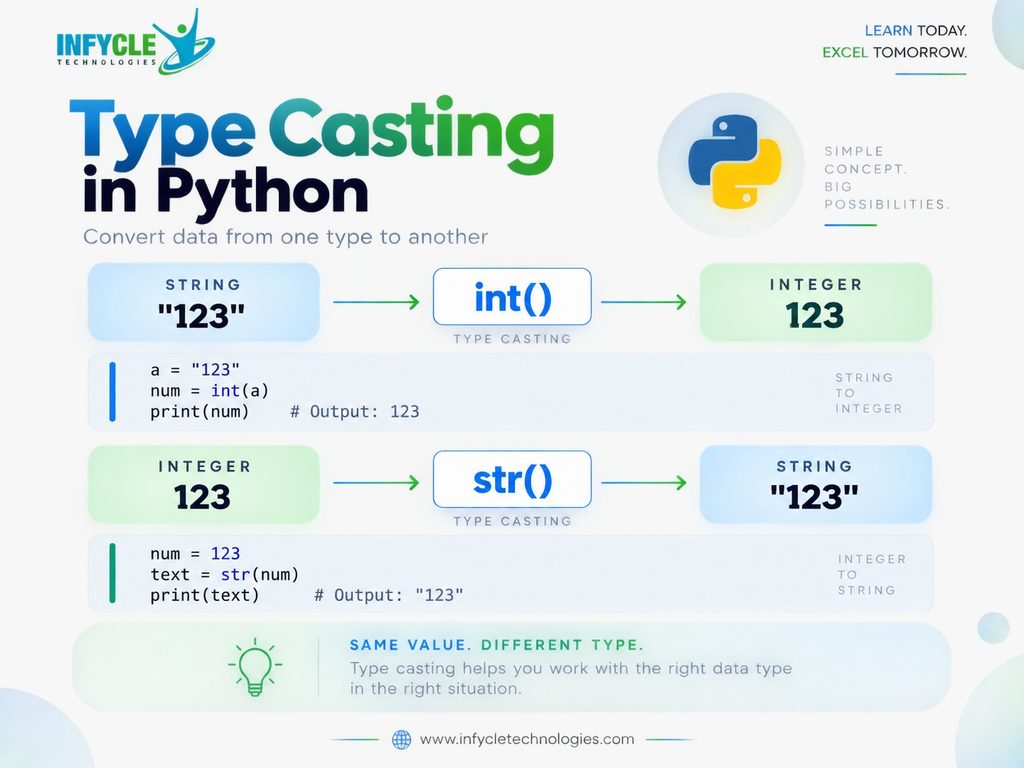
Type Casting in Python is the process of changing a value from one data type to another. Therefore, it allows developers to work with data in the format required by a program.
Python provides several built-in functions for common conversions. For instance, int(), float(), str(), and bool() are frequently used for type conversion.
Consider this simple example:
age = "25"
age_number = int(age)

print(age_number)
print(type(age_number))
Here, the value "25" starts as a string. However, int() converts it into the integer 25.
Common Python Type Conversion Functions
| Function | Converts Value Into | Example |
|---|---|---|
int() | Integer | int("10") |
float() | Floating-point number | float("10.5") |
str() | String | str(100) |
bool() | Boolean | bool(1) |
list() | List | list("ABC") |
tuple() | Tuple | tuple([1, 2]) |
set() | Set | set([1, 2, 2]) |
In simple terms, these functions help Python understand how you want to use a value.
For example, a number received from a form may arrive as text. Therefore, converting that value into an integer allows mathematical operations.
marks = "85"
result = int(marks)

print(result + 5)
The output is:
90Why Choose a Type Casting in Python Course in Chennai?
Learning Type Casting in Python through practical exercises can help beginners understand how Python handles different types of data. Consequently, students can build stronger foundations before moving into advanced programming topics.
Python is widely used across areas such as web development, data analytics, automation, artificial intelligence, and testing. Therefore, learning its fundamentals can support several technology career paths.
Why Type Conversion Matters for Beginners
Type conversion becomes important whenever different data types interact. For instance, adding a string and an integer directly can produce an error.
number = "20"
print(number + 10)
This code produces a TypeError because Python does not automatically combine these two types in this situation.
Instead, you can convert the string first:
number = "20"
print(int(number) + 10)
The result is:
30Furthermore, this concept helps learners understand errors instead of simply memorizing syntax.
Students in Chennai can also practice these concepts through small coding exercises. With guided practice, learners can gradually move from basic variables to functions, object-oriented programming, and real projects.
Key Modules Covered in a Type Casting in Python Course
A strong learning path should cover Type Casting in Python along with variables, operators, conditions, loops, functions, and data structures. As a result, students can understand how individual concepts work together.
Basic Data Types
Python supports several important data types, including integers, floats, strings, booleans, lists, tuples, sets, and dictionaries.
For example:
price = 99
rating = 4.5
name = "Python"
active = True
Each value has a different type. Therefore, knowing the type helps you choose the right operation.
You can check a value with type():
value = 100
print(type(value))
The output is:
<class 'int'>Implicit Type Conversion
Implicit conversion happens when Python automatically converts one compatible type during an operation. For instance:
number = 10
decimal = 2.5

result = number + decimal
print(result)
Python converts the integer into a floating-point value during the calculation.
Consequently, the output becomes:
12.5Explicit Type Conversion
Explicit conversion happens when the programmer manually converts a value.
number = 25
text = str(number)

print(text)
print(type(text))
Here, the integer becomes a string.
Similarly, you can convert a decimal value into an integer:
price = 99.90
whole_price = int(price)

print(whole_price)
The output is:
99However, remember that converting a float to an integer removes the decimal portion. It does not round the number.
Type Casting with User Input
The input() function returns data as a string. Therefore, type conversion becomes especially useful when users enter numbers.
age = input("Enter your age: ")
age = int(age)

print(age + 1)
For example, if the user enters 22, Python converts the input into an integer before performing the calculation.
Practical Tools You Master in Type Casting in Python Training
Practical training should teach learners how to test conversions, identify errors, and apply them inside small programs. Furthermore, learners can practice using Python’s interactive interpreter, code editors, notebooks, and debugging tools.
A simple practice task is a marks calculator:
maths = int(input("Enter Maths mark: "))
science = int(input("Enter Science mark: "))

total = maths + science

print("Total:", total)
This example combines user input, conversion, variables, arithmetic, and output.
In addition, learners can create billing calculators, age calculators, temperature converters, and simple data-entry programs. These exercises make basic syntax more meaningful.
Career Opportunities After Completing a Type Casting in Python Course
Type Casting in Python supports the programming fundamentals required for several entry-level technology roles. However, learners should combine this concept with broader Python skills and project experience.
Python Developer
Python developers build applications, automation scripts, APIs, and backend systems. Therefore, strong fundamentals can provide a useful starting point.
Data Analyst
Data analysts frequently work with numerical and textual data. Consequently, understanding data types and conversions can help when cleaning and preparing datasets.
Automation Tester
Automation testers use Python to create scripts and testing frameworks. In addition, they often handle input values and data from different sources.
Data Science Professional
Data science involves data preparation, analysis, visualization, and machine learning. Therefore, Python fundamentals form an important starting point for this career path.
A structured Python Course in Chennai can help learners connect programming concepts with practical projects. However, career growth depends on consistent practice, portfolio development, problem-solving ability, and interview preparation.
Self-Learning vs. Hands-on Training at Infycle Technologies
| Learning Factor | Self-Learning | Hands-on Training at Infycle Technologies |
|---|---|---|
| Learning pace | Flexible | Structured |
| Mentor support | Limited | Trainer guidance |
| Doubt clarification | Self-research | Direct support |
| Practical exercises | Depends on learner | Guided practice |
| Projects | Self-planned | Practice-oriented |
| Interview preparation | Self-managed | Career-focused support |
| Learning consistency | Requires discipline | Batch-based structure |
Self-learning offers flexibility and access to many online resources. However, learners may struggle when they encounter errors or need a clear learning path.
On the other hand, instructor-led training provides structured lessons and opportunities to ask questions. Furthermore, practical assignments can help learners apply concepts immediately.
Frequently Asked Questions About Type Casting in Python
What is Type Casting in Python?
Type Casting in Python converts a value from one data type into another using built-in functions such as int(), float(), and str().
Why is type casting important in Python?
Type casting helps programs work correctly with different types of data. For example, user input often arrives as a string, even when the user enters a number.
What is the difference between implicit and explicit conversion?
Implicit conversion happens automatically during compatible operations. In contrast, explicit conversion requires the programmer to use a conversion function.
Can type casting cause errors?
Yes, invalid conversions can cause errors. For instance, int("hello") raises a ValueError because the text cannot represent a valid integer.
Start Building Practical Python Skills
If you want to strengthen your programming foundation, Infycle Technologies offers practical learning support for students, graduates, and career changers. Type Casting in Python is one of the basic concepts you can practice before progressing toward larger Python projects.
Moreover, learners can explore Python programming through structured lessons, coding exercises, and practical examples. You can also explore training options designed for learners seeking Python Training in Chennai.
Conclusion
Python type conversion is a simple but important programming concept. It allows developers to change values between strings, integers, floats, booleans, and other data types.
Furthermore, understanding implicit and explicit conversion helps beginners write cleaner programs and identify common errors. Regular practice with small programs can make these concepts easier to remember.
For learners planning a career in software development, data analytics, automation, or related fields, choosing the best software training institute in Chennai can provide a structured environment for building practical skills.
Ready to strengthen your Python programming skills?
Connect with Infycle Technologies in Chennai for free career counseling and a live demo. Explore practical learning paths, understand the right course for your career goal, and take the next step toward becoming job-ready.