Top 101+ PHP Interview Questions and Answers
Introduction
This guide covers PHP Interview Questions and Answers for freshers and experienced candidates. The questions are arranged from beginner to advanced topics so you can use them for quick revision before an interview.
If you are preparing for a full-stack development role, PHP knowledge becomes even more useful when combined with HTML, CSS, JavaScript, MySQL, APIs, Git, and backend development concepts. Candidates considering a Full Stack Developer course in Chennai can also use these questions to identify the PHP topics they should practise.
Table of Contents
- Basic PHP Interview Questions
- PHP Variables and Data Types
- PHP Operators and Control Statements
- Functions and Arrays
- Object-Oriented PHP Questions
- PHP and MySQL Questions
- Advanced PHP Questions
- PHP Security Questions
- Practical PHP Interview Questions
- FAQs
- Conclusion
Basic PHP Interview Questions and Answers
1. What is PHP?
PHP is a server-side scripting language mainly used for developing dynamic websites and web applications.
2. What does PHP stand for?
PHP originally stood for Personal Home Page. It is now commonly referred to as PHP: Hypertext Preprocessor.
3. Is PHP a frontend or backend language?
PHP is primarily a backend/server-side programming language.
4. What is the current use of PHP?
PHP is used for websites, web applications, APIs, content management systems, and server-side application development.
5. How do you write PHP code?
PHP code is commonly placed between <?php and ?> tags.
6. How do you print output in PHP?
You can use echo or print.
echo "Hello World";7. Is PHP case-sensitive?
PHP variable names are case-sensitive. Keywords and function behavior have some different rules, so developers should follow consistent naming practices.
8. What is a PHP variable?
A variable stores a value that can be used during program execution.
$name = "John";9. How does a PHP variable start?
A PHP variable starts with the $ symbol.
10. What is a constant in PHP?
A constant is a value that is intended to remain unchanged during execution.
11. How can you create a constant?
You can use define() or the const keyword.
12. What is isset()?
isset() checks whether a variable exists and has a value other than null.
13. What is empty()?
empty() checks whether a variable is considered empty.
14. What is null in PHP?
null represents the absence of a value.
15. What is the difference between echo and print?
Both can display output. echo can accept multiple arguments, while print returns a value and is generally used with one argument.
PHP Variables and Data Types [PHP Interview Questions and Answers]
16. What are common PHP data types?
Common types include:
- String
- Integer
- Float
- Boolean
- Array
- Object
- Null
- Resource
17. What is a string?
A string is a sequence of characters.
$name = "Siva";18. What is an integer?
An integer is a whole number without a decimal component.
$age = 25;19. What is a Boolean?
A Boolean has two possible values: true or false.
20. What is an array?
An array stores multiple values in a single variable.
$skills = ["PHP", "MySQL", "JavaScript"];21. What is type juggling?
Type juggling occurs when PHP automatically converts a value from one type to another when required.
22. What is type casting?
Type casting explicitly converts a value into another data type.
$number = (int) "25";23. What does var_dump() do?
var_dump() displays information about a variable, including its type and value.
24. What does print_r() do?
print_r() provides a readable representation of arrays and objects.
25. What is string concatenation?
String concatenation joins strings using the . operator.
$fullName = $firstName . $lastName;PHP Operators and Control Statements
26. What are arithmetic operators?
They perform calculations such as addition, subtraction, multiplication, division, and modulus.
27. What is the difference between == and ===?
== compares values after type conversion when applicable. === compares both value and type.
28. What does != mean?
It checks whether two values are not equal.
29. What does && mean?
It represents logical AND.
30. What does || mean?
It represents logical OR.
31. What is an if statement?
It executes code when a specified condition is true.
32. What is else?
else executes when the preceding condition is false.
33. What is elseif?
elseif allows another condition to be checked when the previous condition is false.
34. What is a switch statement?
switch is useful when comparing one expression against multiple possible values.
35. What is a loop?
A loop repeatedly executes a block of code while a specified condition or iteration rule applies.
36. What types of loops are commonly used in PHP?
Common loops include for, while, do-while, and foreach.
37. What is foreach used for?
foreach is commonly used to iterate through arrays.
38. What does break do?
break terminates a loop or switch statement.
39. What does continue do?
continue skips the current iteration and moves to the next iteration.
40. What is the ternary operator?
It provides a short way to write a simple conditional expression.
$result = $age >= 18 ? "Adult" : "Minor";PHP Functions and Arrays
41. What is a function?
A function is a reusable block of code designed to perform a particular task.
42. How do you create a function?
Use the function keyword.
function greet() {
    echo "Hello";
}
43. What is a function parameter?
A parameter is a value received by a function when it is called.
44. What does return do?
return sends a value back from a function and can end its execution.
45. What is a built-in PHP function?
It is a function provided by PHP, such as strlen(), count(), and array_push().
46. What is an indexed array?
An indexed array uses numeric indexes.
47. What is an associative array?
An associative array uses named keys.
$user = [
    "name" => "John",
    "age" => 25
];
48. What is a multidimensional array?
It is an array containing other arrays.
49. What does count() do?
It returns the number of elements in an array or countable value.
50. What does array_push() do?
It adds one or more elements to the end of an array.
51. What does sort() do?
It sorts an array in ascending order.
52. What does explode() do?
It splits a string into an array based on a delimiter.
53. What does implode() do?
It joins array elements into a string using a specified separator.
54. What is an anonymous function?
An anonymous function is a function without a declared name and can be assigned to a variable or passed as an argument.
55. What is variable scope?
Scope determines where a variable can be accessed, such as local, global, or static scope.
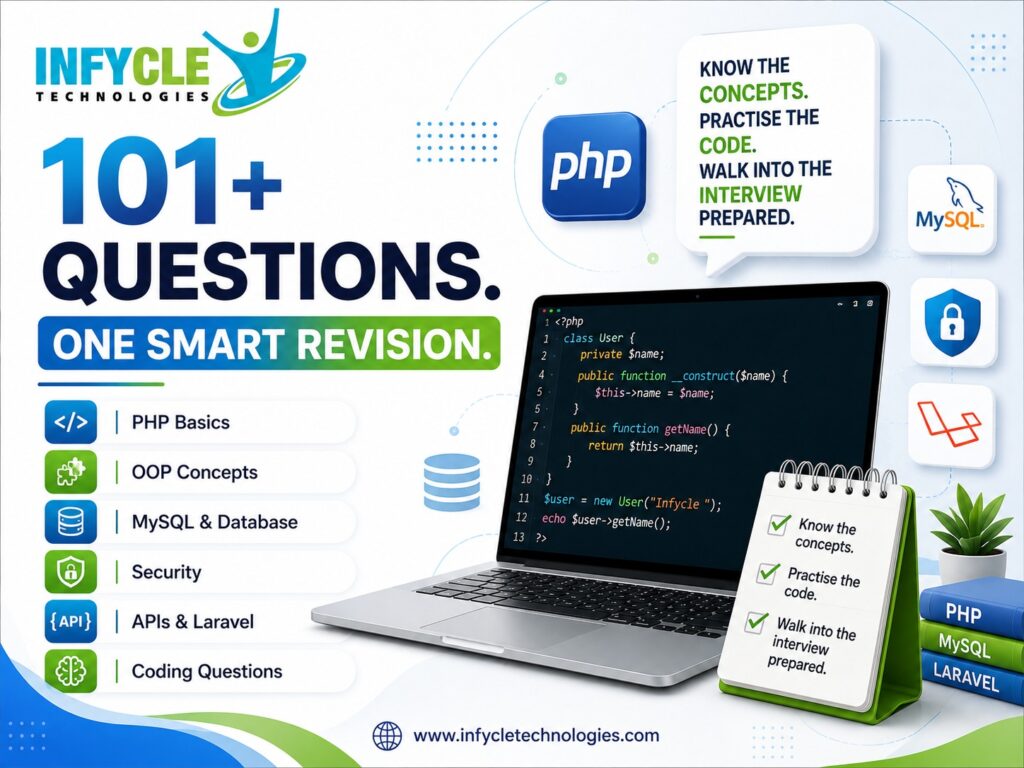
Object-Oriented PHP Interview Questions and Answers
56. What is OOP?
Object-oriented programming organizes software around objects containing data and behavior.
57. What is a class?
A class is a blueprint used to create objects.
58. What is an object?
An object is an instance of a class.
59. What is a constructor?
A constructor is a special method that is automatically called when an object is created.
60. What is a destructor?
A destructor is called when an object is being destroyed.
61. What is inheritance?
Inheritance allows a class to derive properties and methods from another class.
62. What is encapsulation?
Encapsulation groups data and related methods while controlling access to internal implementation.
63. What is polymorphism?
Polymorphism allows different classes or implementations to provide different behavior through a common interface or method structure.
64. What is abstraction?
Abstraction focuses on essential behavior while hiding unnecessary implementation details.
65. What is an interface?
An interface defines a contract that implementing classes must follow.
66. What is a trait?
A trait allows reusable methods to be included in multiple classes.
67. What is method overriding?
A child class provides its own implementation of a method inherited from its parent class.
68. What are access modifiers?
PHP provides public, protected, and private visibility levels.
69. What is public?
A public property or method can generally be accessed from outside the class.
70. What is private?
A private property or method can only be accessed within the class that defines it.
PHP and MySQL Interview Questions
71. How does PHP connect to MySQL?
PHP applications commonly connect to MySQL using MySQLi or PDO.
72. What is MySQL?
MySQL is a relational database management system used to store and manage structured data.
73. What is PDO?
PDO is PHP’s database access interface that provides a consistent way to work with different database systems.
74. What is MySQLi?
MySQLi is a PHP extension designed specifically for MySQL database interaction.
75. What is a prepared statement?
A prepared statement separates SQL structure from supplied values and helps reduce SQL injection risks.
76. What is SQL injection?
SQL injection is a security vulnerability where malicious input can alter an application’s SQL query.
77. How can SQL injection be prevented?
Use prepared statements, validate input appropriately, apply least-privilege database permissions, and avoid directly concatenating untrusted input into SQL queries.
78. What is CRUD?
CRUD stands for:
- Create
- Read
- Update
- Delete
These represent common database operations.
79. What is a primary key?
A primary key uniquely identifies a record in a database table.
80. What is a foreign key?
A foreign key creates a relationship between records in different database tables.
Advanced PHP Interview Questions and Answers
81. What is a session in PHP?
A session allows an application to maintain user-related state across multiple requests.
82. What is a cookie?
A cookie stores small pieces of data in the user’s browser.
83. What is the difference between sessions and cookies?
Sessions are primarily managed on the server, while cookies are stored on the client side.
84. What is an API?
An API allows different software systems to communicate with each other.
85. What is REST API?
A REST API is an HTTP-based architectural approach commonly used to expose resources through endpoints.
86. What is JSON?
JSON is a lightweight data-interchange format commonly used between web applications and APIs.
87. What does json_encode() do?
It converts a PHP value into a JSON representation.
88. What does json_decode() do?
It converts JSON data into a PHP value.
89. What is Composer?
Composer is a dependency manager widely used in PHP projects.
90. What is MVC?
MVC stands for Model, View, and Controller. It separates application data, presentation, and request-handling logic.
91. What is Laravel?
Laravel is a popular PHP framework used for developing web applications.
92. What is middleware?
Middleware processes requests before they reach a particular application action or after processing, depending on the framework and configuration.
93. What is routing?
Routing determines which application code should handle a particular URL or HTTP request.
94. What is namespace in PHP?
Namespaces help organize code and prevent naming conflicts between classes, functions, and constants.
95. What is an exception?
An exception represents an unusual condition that can be handled using PHP’s exception-handling mechanisms.
PHP Security Interview Questions
96. What is XSS?
Cross-Site Scripting, or XSS, occurs when untrusted content is improperly handled and executable script can be injected into a web page.
97. How can XSS be reduced?
Validate input where appropriate and correctly escape output according to its context.
98. What is CSRF?
Cross-Site Request Forgery tricks an authenticated user into sending an unintended request to an application.
99. How can passwords be stored securely?
Use PHP’s password hashing functions such as password_hash() rather than storing plain-text passwords.
100. What is input validation?
Input validation checks whether submitted data meets expected rules before the application processes it.
101. Why is HTTPS important for PHP applications?
HTTPS encrypts communication between the browser and server, helping protect sensitive information while it is transmitted.
Practical PHP Interview Questions and Answers
102. How would you validate a user registration form?
Validate required fields, check expected formats, sanitize or appropriately handle input, securely hash passwords, use prepared database statements, and return useful validation errors.
103. How would you build a login system?
A typical login system validates credentials, retrieves the user securely, verifies the password with password_verify(), starts a session, and applies appropriate session security controls.
104. How would you create a PHP CRUD application?
Create the database structure, build forms, implement Create/Read/Update/Delete operations, connect through PDO or MySQLi, validate input, use prepared statements, and test each operation.
105. How can you improve PHP application performance?
Reduce unnecessary database queries, optimise database access, use caching where appropriate, avoid inefficient processing, optimise assets, and profile slow parts of the application.
How to Prepare for PHP Interviews
Knowing definitions alone is not enough for a technical interview. Practise writing small programs and explaining why your solution works.
Focus on these areas:
Beginner: syntax, variables, data types, operators, conditions, loops, and functions.
Intermediate: arrays, forms, sessions, cookies, file handling, MySQL, CRUD, OOP, and error handling.
Advanced: APIs, authentication, security, Composer, frameworks, database optimisation, testing, and application architecture.
For full-stack positions, also revise HTML, CSS, JavaScript, SQL, Git, REST APIs, and basic frontend-backend integration.
Frequently Asked Questions
Are PHP interview questions suitable for freshers?
Yes. Freshers are commonly expected to understand PHP fundamentals such as variables, data types, operators, functions, arrays, OOP, database connectivity, and basic security. Practising beginner questions first helps build the foundation needed for coding tests and technical discussions.
Which PHP topics should I prepare for an interview?
Focus on PHP syntax, variables, arrays, functions, OOP, error handling, sessions, cookies, MySQL, PDO, SQL, APIs, and security. For full-stack roles, also prepare JavaScript, HTML, CSS, Git, REST APIs, and database concepts.
Is PHP useful for full-stack development?
Yes. PHP can be used for backend development and can work with frontend technologies such as HTML, CSS, and JavaScript. PHP applications can also use databases, APIs, frameworks, and modern development tools, making PHP relevant to many web development projects.
How can I prepare for a PHP interview as a fresher?
Start with PHP fundamentals and gradually move to OOP, MySQL, CRUD applications, APIs, and security. Build two or three small projects and practise explaining your code. A structured Full Stack Developer training in Chennai program can also help if you prefer guided learning.
Is Laravel important for PHP interviews?
Laravel can be important for positions that specifically require Laravel or modern PHP framework experience. However, candidates should first understand core PHP, OOP, databases, HTTP, and web development fundamentals because frameworks build on these concepts.
Conclusion
These PHP Interview Questions and Answers cover the core areas that candidates should revise before a PHP or web development interview. Instead of memorising every answer, understand the concept and practise writing working code.
If your goal is to become a full-stack developer, combine PHP with MySQL, HTML, CSS, JavaScript, REST APIs, Git, and a PHP framework such as Laravel. Practical projects can also help you demonstrate your skills during interviews.
A structured Full Stack Developer course in Chennai can be useful for learners who want to follow a guided path from PHP fundamentals to complete web application development.
Final CTA
When choosing a Best Software Training Institute in Chennai, compare the curriculum carefully. Look for practical PHP and MySQL projects, frontend development, APIs, Git, framework training, debugging practice, and interview preparation.
Infycle Technologies can be considered as one learning option for candidates interested in structured full-stack development training in Chennai. Focus on developing real coding skills and building projects that you can confidently explain during an interview.