Top AWS Certifications for Cloud Professionals
Introduction
AWS currently offers certifications across Foundational, Associate, Professional, and Specialty levels. Each certification is designed for a different type of cloud responsibility, so the right choice depends on your experience and career goal rather than simply choosing the highest-level exam.
For beginners, the AWS Certified Cloud Practitioner provides a foundation in AWS Cloud concepts and services. Technical professionals can then choose certifications aligned with roles such as solutions architecture, development, cloud operations, data engineering, machine learning, or DevOps.
This guide explains the top AWS Certifications, who they are suitable for, what skills they validate, how to choose between them, and how beginners in Chennai can prepare for an AWS-focused career.
Table of Contents
- What Are AWS Certifications?
- Best AWS Certifications by Career Goal
- AWS Certified Cloud Practitioner
- AWS Certified Solutions Architect – Associate
- AWS Certified Developer – Associate
- AWS Certified CloudOps Engineer – Associate
- AWS Certified Data Engineer – Associate
- AWS Certified Machine Learning Engineer – Associate
- AWS Certified DevOps Engineer – Professional
- How to Choose the Right AWS Certification
- AWS Certification Learning Roadmap
- Common Certification Mistakes
- Frequently Asked Questions
- Conclusion
What Are AWS Certifications?
AWS Certifications are credentials that validate knowledge and skills related to Amazon Web Services. AWS groups its certifications into four levels: Foundational, Associate, Professional, and Specialty. The levels help candidates choose a certification based on their current knowledge and career responsibilities.
Certification is useful because it gives employers a structured way to verify a candidate’s knowledge. However, certification should not replace hands-on practice.
For technical cloud roles, you should combine certification preparation with practical work using services such as EC2, S3, IAM, VPC, RDS, Lambda, CloudWatch, and other relevant AWS services.
Best AWS Certifications by Career Goal
There is no single “best” AWS certification for everyone. Your target role should determine your choice.
| Career Goal | Recommended Certification |
|---|---|
| Cloud beginner | AWS Certified Cloud Practitioner |
| Cloud Architect | AWS Certified Solutions Architect – Associate |
| Cloud Developer | AWS Certified Developer – Associate |
| Cloud Operations | AWS Certified CloudOps Engineer – Associate |
| Data Engineer | AWS Certified Data Engineer – Associate |
| ML Engineer | AWS Certified Machine Learning Engineer – Associate |
| DevOps Engineer | AWS Certified DevOps Engineer – Professional |
| Cloud Security | AWS Certified Security – Specialty |
| Advanced Networking | AWS Certified Advanced Networking – Specialty |
AWS’s current certification portfolio includes these role-focused paths, along with other certifications.
AWS Certified Cloud Practitioner
The AWS Certified Cloud Practitioner is a Foundational-level certification designed to validate a general understanding of AWS Cloud, services, and terminology.
It can be a useful starting point for people who are new to cloud computing or who do not have an IT background. AWS specifically describes it as suitable for candidates with limited or no prior IT experience and for professionals who need foundational cloud knowledge.
Who should choose it?
It is suitable for:
- College students exploring cloud careers
- Fresh graduates
- Non-technical professionals
- Career changers
- Beginners with limited AWS exposure
It is not intended to prove deep hands-on engineering ability. If your goal is to become a cloud engineer, you will usually need to continue into a technical Associate-level certification and practical learning.
AWS Certified Solutions Architect – Associate
The AWS Certified Solutions Architect – Associate focuses on designing distributed systems on AWS. It is one of the most relevant certifications for professionals interested in cloud architecture and infrastructure design.
AWS describes this certification as validating technical skills in designing distributed systems and applying the AWS Well-Architected Framework.
What can you learn?
You should understand areas such as:
- Compute
- Storage
- Databases
- Networking
- Security
- Scalability
- Reliability
- Cost optimisation
This certification can be a strong choice if you want to understand how different AWS services work together to build reliable applications.
AWS Certified Developer – Associate
The AWS Certified Developer – Associate is designed for professionals who develop and maintain applications on AWS. It validates knowledge related to developing, deploying, and debugging cloud-based applications.
This path can suit developers who already understand programming and want to build cloud-based applications.
Practical learning should include services such as Lambda, API Gateway, DynamoDB, S3, IAM, and application deployment concepts.
AWS Certified CloudOps Engineer – Associate
AWS renamed the former AWS Certified SysOps Administrator – Associate to AWS Certified CloudOps Engineer – Associate with the updated SOA-C03 exam. The certification focuses on deploying, managing, and operating workloads on AWS.
It is particularly relevant to cloud operations professionals.
The certification covers areas such as:
- Monitoring
- Security controls
- Networking
- Business continuity
- Cost optimisation
- Performance optimisation
- Workload operations
AWS recommends approximately one year of experience with deployment, management, networking, and security on AWS for the ideal candidate.
AWS Certified Data Engineer – Associate
The AWS Certified Data Engineer – Associate is aimed at professionals working with data pipelines and data stores on AWS.
It validates skills in implementing data pipelines and optimising data-related solutions for cost and performance.
This can be relevant for professionals interested in:
- Data engineering
- Data pipelines
- Data storage
- Analytics infrastructure
- Cloud data platforms
If you already have an interest in data analytics or data engineering, this certification can complement your existing technical skills.
AWS Certified Machine Learning Engineer – Associate
The AWS Certified Machine Learning Engineer – Associate focuses on implementing and operationalising machine learning solutions on AWS.
It is more specialised than a general cloud certification and is better suited to professionals who already understand machine learning concepts and want to work with ML workloads on AWS.
AWS is also updating this certification. Registration for the updated MLA-C02 beta is scheduled to open September 1, 2026, while the current English MLA-C01 exam is scheduled to remain available until September 28, 2026. Candidates planning this certification should therefore check the latest AWS exam information before scheduling.
AWS Certified DevOps Engineer – Professional
For experienced DevOps professionals, the AWS Certified DevOps Engineer – Professional validates advanced skills in provisioning, operating, and managing distributed application systems on AWS.
AWS describes the target candidate as a DevOps engineer with two or more years of experience working with AWS environments.
This certification is more advanced than the Associate-level certifications and can be relevant to professionals working with:
- Continuous integration and delivery
- Infrastructure automation
- Monitoring
- Deployment
- Security
- Reliability
- Distributed applications
If you are a complete beginner, this should not normally be your first AWS certification.
How to Choose the Right AWS Certification
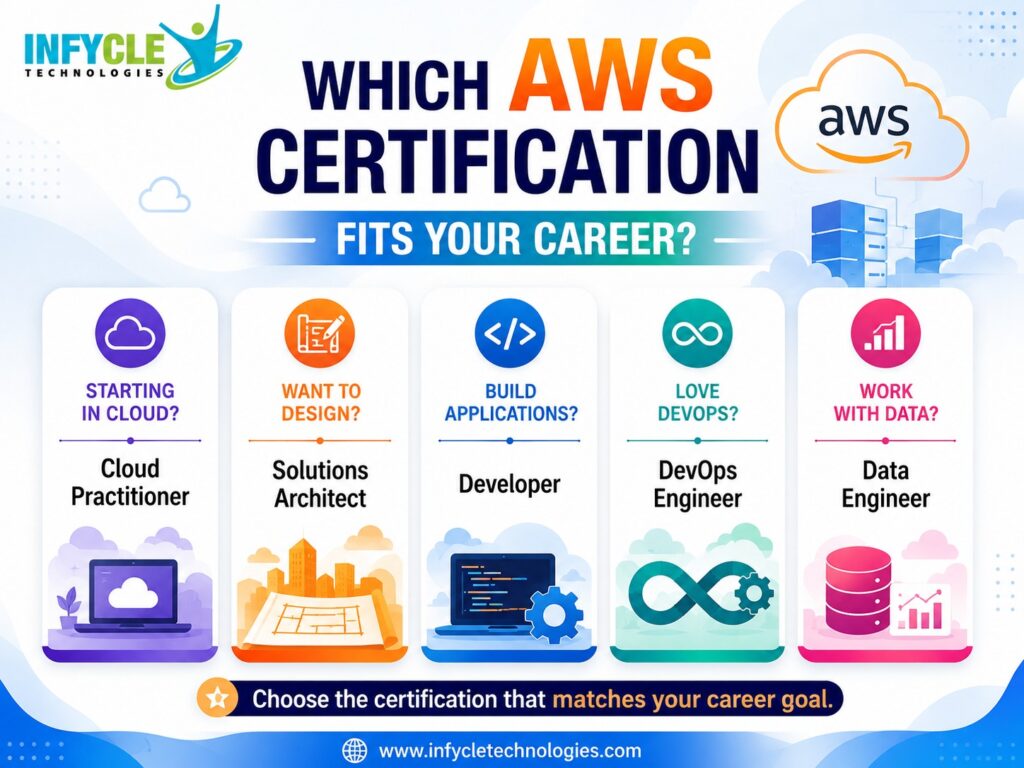
Start with your current level rather than choosing a certification based only on popularity.
If You Are a Complete Beginner
Start with Cloud Practitioner to understand cloud concepts and AWS terminology.
If You Want a Cloud Engineering Career
Consider Solutions Architect – Associate or CloudOps Engineer – Associate, depending on whether you prefer architecture or operations.
If You Are a Developer
Developer – Associate is more closely aligned with application development on AWS.
If You Like Data
Consider Data Engineer – Associate if you want to work with cloud data pipelines and data stores.
If You Like Machine Learning
Build your ML fundamentals first, then consider Machine Learning Engineer – Associate.
If You Already Work in DevOps
The DevOps Engineer – Professional can be a suitable advanced certification once you have the required practical experience.
AWS Certification Learning Roadmap
A certification is more useful when you connect exam preparation with hands-on learning.
Step 1: Learn Cloud Fundamentals
Understand regions, availability zones, networking, storage, compute, databases, security, and pricing concepts.
Step 2: Learn Core AWS Services
Practise with services relevant to your target role.
For example, a cloud engineer should become comfortable with EC2, S3, IAM, VPC, RDS, CloudWatch, and related services.
Step 3: Build Small Projects
Create practical projects instead of only watching tutorials.
You could deploy a simple web application, configure a secure storage solution, create a serverless application, or build a basic CI/CD workflow.
Step 4: Study the Official Exam Guide
AWS publishes exam guides containing the exam content outline, target candidate information, and relevant AWS services.
Step 5: Practise Before Booking the Exam
AWS recommends using exam-style questions, learning resources, hands-on labs, and practice assessments as part of exam preparation.
Common AWS Certification Mistakes
One common mistake is collecting certifications without developing practical skills. A certification can validate knowledge, but employers may still expect you to understand how cloud services work in real projects.
Another mistake is choosing a Professional-level certification too early. Advanced certifications are designed for professionals with significant practical experience.
Avoid memorising practice questions. Instead, understand why a particular AWS service is appropriate for a specific scenario.
You should also check the current AWS exam version before preparing. AWS regularly updates certification exams, and some certification names and exam versions change over time.
Mid-Article Learning Tip
If your goal is to move into cloud or DevOps, compare a training program’s syllabus with the certification’s official exam guide.
Look for practical coverage of AWS services, Linux, networking, Git, Docker, CI/CD, infrastructure automation, monitoring, and security where relevant to your target role.
For beginners in Chennai, structured aws devops course in chennai can provide a guided environment for learning cloud and DevOps concepts instead of trying to combine unrelated tutorials on your own.
Frequently Asked Questions
Which AWS certification is best for beginners?
The AWS Certified Cloud Practitioner is generally the most accessible starting point for beginners because it validates foundational AWS Cloud knowledge rather than advanced technical skills. AWS specifically positions it for candidates who may have little or no prior IT or cloud experience. Technical learners can then move toward an Associate-level certification.
Which AWS certification is best for a cloud engineer?
There is no universal answer, but Solutions Architect – Associate and CloudOps Engineer – Associate are strong role-aligned options. Solutions Architect focuses on designing AWS solutions, while CloudOps Engineer focuses more on deploying, managing, and operating workloads. Your target responsibilities should determine the choice.
Is AWS certification enough to get a job?
AWS certification alone does not guarantee employment. It can validate your knowledge, but employers may also expect hands-on cloud experience, projects, Linux, networking, scripting, security, and role-specific skills. A portfolio showing how you used AWS services can make your profile more practical and easier to evaluate.
Is AWS DevOps certification suitable for freshers?
The AWS Certified DevOps Engineer – Professional is an advanced certification intended for experienced DevOps professionals. AWS’s target candidate profile includes two or more years of experience with AWS environments. Freshers should generally build cloud fundamentals and practical DevOps skills first rather than starting with the Professional exam.
How long is an AWS certification valid?
AWS certifications are generally valid for three years from the date they are earned. AWS provides different recertification options depending on the certification, including passing a current exam or completing certain approved maintenance paths.
Can non-technical students learn AWS?
Yes. Non-technical learners can start with cloud fundamentals and gradually build technical skills. The Cloud Practitioner certification is specifically designed to validate foundational AWS knowledge and can be a reasonable starting point for people without an IT background. Moving into technical cloud roles will require additional learning in areas such as Linux, networking, scripting, security, and AWS services.
Conclusion
The right AWS certification depends on your career target, current knowledge, and practical experience. Beginners can start with Cloud Practitioner, while technical professionals can choose Associate-level certifications based on architecture, development, cloud operations, data engineering, or machine learning.
Experienced professionals can progress toward certifications such as AWS Certified DevOps Engineer – Professional, while specialised roles may benefit from certifications in security or advanced networking. AWS’s official certification framework provides clear role-based pathways across these levels.
If you are preparing for a cloud career, AWS DevOps training in Chennai can help you build practical skills alongside certification preparation. A good learning path should connect AWS concepts with hands-on projects, Linux, networking, automation, CI/CD, containers, monitoring, and security.
Final CTA
Before choosing a certification or training program, compare the official AWS exam requirements with the course syllabus. Look for practical labs, projects, updated AWS services, DevOps tools, and interview preparation rather than focusing only on certification completion.
For learners looking for structured cloud and DevOps education, Infycle Technologies can be considered as a Best Software Training Institute in Chennai option. The goal should be to build practical cloud skills that you can demonstrate through projects and apply in real-world scenarios.