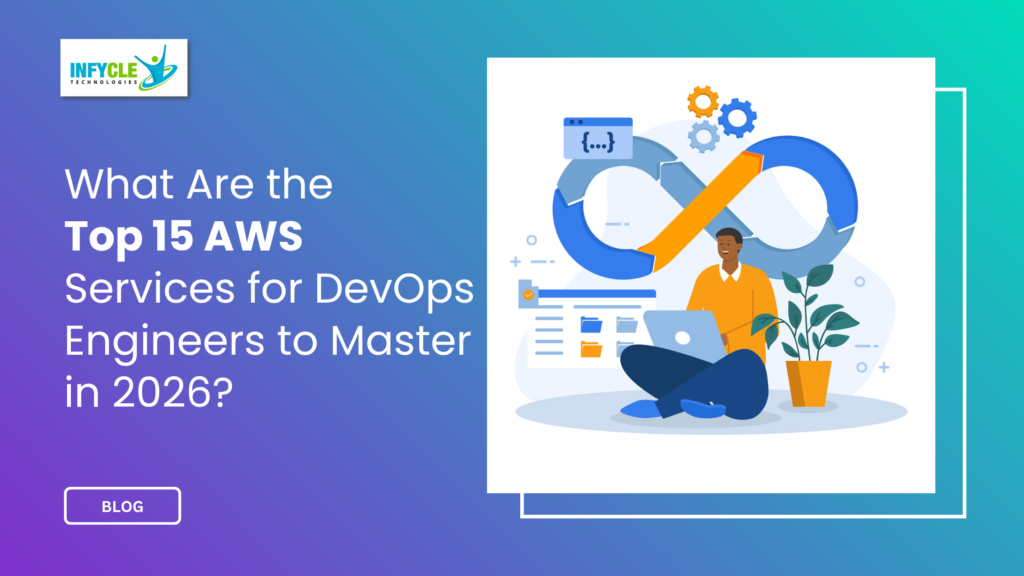
What Are the Top 15 AWS Services for DevOps Engineers to Master in 2026?
One of the biggest advantages of entering the cloud ecosystem today is the vast range of AWS Services for DevOps that help organizations automate deployments, improve scalability, enhance security, and reduce operational costs. According to industry reports, AWS maintains a significant share of the global cloud market, making AWS expertise one of the most valuable skills employers look for in 2026.
For learners in Chennai and other growing technology hubs, mastering AWS tools can open doors to careers in cloud engineering, DevOps, site reliability engineering, and infrastructure automation. Let’s explore the top AWS services every aspiring DevOps engineer should learn to stay competitive in 2026.
Why AWS Skills Are Essential for DevOps Careers in 2026
Modern software development relies heavily on automation, continuous integration, continuous deployment, and cloud infrastructure management. Organizations are increasingly shifting away from traditional infrastructure and embracing cloud-native technologies.
This shift has created strong demand for professionals who understand:
- Cloud infrastructure management
- Automated deployments
- Infrastructure as Code (IaC)
- Container orchestration
- Monitoring and logging
- Security automation
The good news? Many of these skills can be learned even without a technical background if you follow a structured learning path.
Top 15 AWS Services for DevOps Engineers to Master
1. Amazon EC2 (Elastic Compute Cloud)
Amazon EC2 is often the first service beginners encounter when learning AWS.
It allows organizations to launch virtual servers in the cloud, making it easier to host applications, websites, and enterprise systems without maintaining physical hardware.
Key DevOps use cases:
- Application hosting
- Server management
- Auto scaling environments
- Testing and development setups
2. AWS Lambda
Serverless computing continues to gain popularity in 2026.
AWS Lambda enables developers to run code without managing servers. DevOps teams use Lambda for automation tasks, event-driven workflows, and cost-efficient application management.
Benefits include:
- No server maintenance
- Pay only for execution time
- Faster deployment cycles
3. Amazon S3
Amazon S3 remains one of the most widely used storage services in AWS.
DevOps engineers use S3 for:
- Backup storage
- Log management
- Static website hosting
- Artifact storage in CI/CD pipelines
Its durability and scalability make it essential for modern cloud environments.
4. AWS CodePipeline
When discussing AWS Services for DevOps, CodePipeline deserves special attention.
It automates the software release process by integrating source code repositories, build tools, testing frameworks, and deployment systems into a single workflow.
Benefits:
- Faster software delivery
- Reduced deployment errors
- Consistent release processes
How DevOps Engineers Build Modern CI/CD Pipelines
A typical DevOps workflow often combines several AWS services working together:
- CodeCommit stores source code
- CodeBuild compiles applications
- CodePipeline automates workflows
- CodeDeploy releases applications
- CloudWatch monitors performance
This integrated ecosystem is one reason AWS remains a preferred platform for DevOps teams worldwide. If you’re planning to enter cloud computing and DevOps, focus on hands-on projects rather than only theoretical learning. Practical exposure to AWS deployment pipelines, containers, and automation tools significantly improves employability and interview confidence.
5. AWS CodeBuild
CodeBuild automates the compilation, testing, and packaging of source code.
It eliminates the need to manage dedicated build servers and integrates seamlessly with CI/CD workflows.
6. AWS CodeDeploy
CodeDeploy automates software deployment across multiple environments.
DevOps teams use it to:
- Deploy applications consistently
- Reduce downtime
- Roll back failed deployments quickly
7. Amazon ECS (Elastic Container Service)
Containers have become standard in modern software development.
Amazon ECS simplifies container deployment and management while integrating directly with AWS infrastructure.
8. Amazon EKS (Elastic Kubernetes Service)
Kubernetes continues to dominate container orchestration.
Amazon EKS provides a managed Kubernetes environment, allowing DevOps engineers to deploy scalable applications without handling complex infrastructure maintenance.
9. AWS CloudFormation
Infrastructure as Code is no longer optional.
CloudFormation enables teams to define infrastructure using templates, ensuring consistency across environments and reducing manual configuration errors.
Among all AWS Services for DevOps, CloudFormation is particularly valuable because it supports repeatable and automated infrastructure deployment.
10. AWS Systems Manager
Managing hundreds of servers manually is impractical.
Systems Manager helps automate operational tasks such as:
- Patch management
- Configuration updates
- Resource monitoring
- Compliance management
11. Amazon CloudWatch
Monitoring is a critical component of successful DevOps practices.
CloudWatch provides:
- Real-time metrics
- Application monitoring
- Log analysis
- Performance alerts
Strong monitoring helps teams detect issues before they impact users.
12. AWS IAM (Identity and Access Management)
Security remains a top priority in cloud environments.
IAM enables organizations to control user permissions, define access policies, and implement secure authentication mechanisms.
13. AWS Secrets Manager
Modern applications rely heavily on API keys, credentials, and database passwords.
Secrets Manager securely stores and manages sensitive information while reducing security risks.
14. AWS Auto Scaling
One of the biggest advantages of cloud infrastructure is elasticity.
Auto Scaling automatically adjusts computing resources based on demand, improving performance while optimizing costs.
Many organizations rely on this service as part of their AWS Services for DevOps strategy.
15. Amazon VPC (Virtual Private Cloud)
Networking fundamentals remain important for DevOps engineers.
Amazon VPC enables organizations to create secure and isolated cloud environments while maintaining control over networking configurations.
AWS Trends DevOps Engineers Should Watch in 2026
The cloud landscape continues to evolve rapidly. Several trends are expected to shape DevOps careers:
AI-Powered Operations
Organizations increasingly use AI for:
- Predictive monitoring
- Incident detection
- Automated remediation
- Performance optimization
Platform Engineering
Many enterprises are building internal developer platforms to simplify software delivery and improve productivity.
Security-First DevOps (DevSecOps)
Security integration throughout the development lifecycle is becoming a standard requirement rather than an optional practice.
Multi-Cloud Strategies
Companies are expanding beyond single-cloud environments, creating demand for professionals who understand cloud architecture principles.
Why Learning AWS Is a Smart Career Move
Whether you’re from Arts, Commerce, Science, or Engineering backgrounds, cloud computing offers opportunities for learners from diverse educational paths.
The demand for AWS-certified professionals continues to grow because organizations need experts who can:
- Automate infrastructure
- Improve deployment speed
- Reduce operational costs
- Enhance application reliability
For learners in Chennai, practical cloud skills can significantly improve employability in startups, product companies, and enterprise organizations.
Frequently Asked Questions
1. Which AWS service should beginners learn first?
Most beginners start with EC2, S3, IAM, and CloudWatch because these services provide a strong foundation for understanding cloud infrastructure.
2. How important are AWS Services for DevOps careers?
They are essential. Modern DevOps roles frequently require expertise in automation, cloud infrastructure, CI/CD pipelines, monitoring, and security services available within AWS.
3. Do I need coding knowledge to learn AWS?
Basic programming knowledge helps, but many AWS concepts can be learned by beginners through structured practical training and guided projects.
4. Which AWS certification is best for aspiring DevOps engineers?
AWS Certified Developer Associate and AWS Certified DevOps Engineer Professional are highly valued certifications.
5. How long does it take to learn AWS DevOps?
With consistent learning and project practice, most beginners can develop job-ready skills within 4–8 months.
Conclusion
The cloud industry continues to create exciting opportunities for professionals who understand automation, infrastructure management, and modern deployment practices. Mastering these 15 AWS services can provide a strong foundation for building a successful DevOps career in 2026 and beyond.
If you’re looking to gain practical experience through real-time projects, expert mentorship, and industry-focused learning, enrolling in an AWS DevOps Training in Chennai program can help accelerate your journey. At Infycle Technologies, learners receive hands-on exposure to cloud platforms, CI/CD tools, automation frameworks, and deployment strategies that align with current industry requirements.