Oracle PL/SQL Interview Questions For Freshers And Experienced

Introduction
Stepping into the IT job market today requires more than just a degree—it demands practical skills and the confidence to prove them. For candidates aiming to work with databases, mastering Oracle PL/SQL can open doors to high-demand roles in development, data management, and enterprise applications.
If you’re in CITY and planning to attend interviews for database-related roles, you’ve likely noticed how frequently PL/SQL appears in job descriptions. Companies are actively looking for candidates who can write efficient queries, manage data, and build backend logic using Oracle technologies.
This guide is designed to help both freshers and experienced professionals understand the most important interview questions, along with the logic behind them. Whether you’re starting from scratch or upgrading your skills, these insights will help you prepare smarter and perform better in interviews.
Why Oracle PL/SQL Skills Are Still in Demand
Even with the rise of new technologies, Oracle PL/SQL remains a core skill in many enterprise environments. Banking, healthcare, and large-scale applications still rely heavily on Oracle databases.
Here’s why it continues to matter in 2026:
- Used in large enterprise systems
- High demand in database and backend roles
- Strong integration with business logic
- Preferred in industries handling sensitive data
Industry reports suggest that database-related roles have seen a steady 15–20% growth, especially for professionals skilled in structured query languages and database programming.
Top Oracle PL/SQL Interview Questions for Freshers
If you’re just starting out, interviewers focus on basics and clarity.
1. What is PL/SQL?
PL/SQL is Oracle’s procedural extension of SQL that allows developers to write structured programs, including loops, conditions, and functions.
2. What is the difference between SQL and PL/SQL?
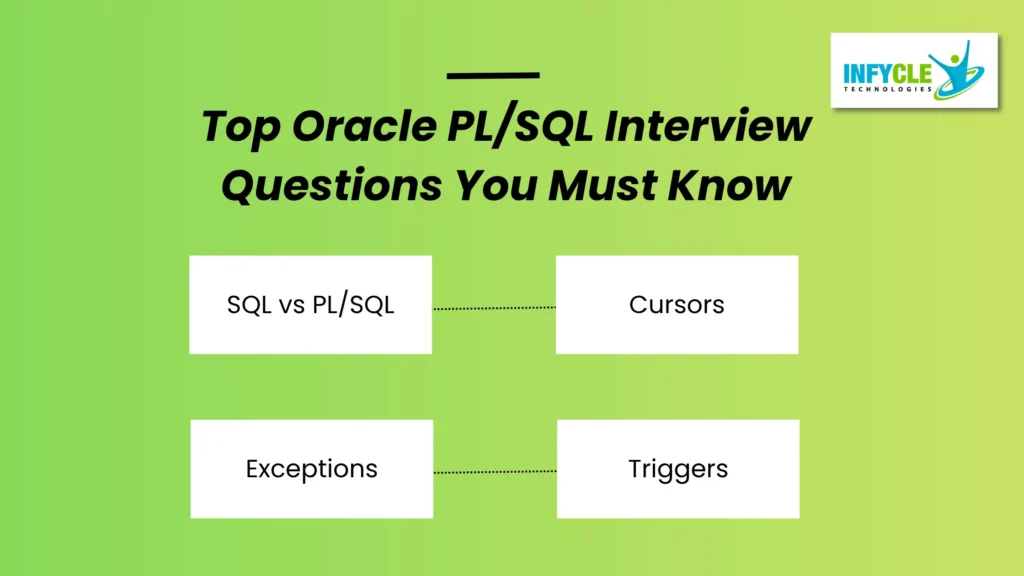
- SQL → Used for querying data
- PL/SQL → Used for writing complete programs with logic
Simple explanation matters more than complex definitions.
3. What are PL/SQL blocks?
PL/SQL code is structured into blocks:
- DECLARE
- BEGIN
- EXCEPTION
- END
4. What is a cursor?
A cursor is used to fetch multiple rows from a query result and process them one by one.
5. What are exceptions in PL/SQL?
Exceptions handle runtime errors, ensuring the program doesn’t crash unexpectedly.
Oracle PL/SQL Interview Questions for Experienced Candidates
For experienced professionals, the focus shifts to optimization, real-world usage, and performance.
1. What are stored procedures and functions?
- Stored Procedure → Performs a task
- Function → Returns a value
2. What is bulk collect and FORALL?
Used for handling large data efficiently, reducing context switching between SQL and PL/SQL engines.
3. How do you optimize PL/SQL code?
- Use indexes
- Avoid unnecessary loops
- Use bulk operations
- Optimize queries
4. What is a trigger?
Triggers automatically execute when certain database events occur (INSERT, UPDATE, DELETE).
5. Explain normalization and denormalization
- Normalization → Reduces redundancy
- Denormalization → Improves performance
If you’re finding it difficult to move from theory to real-time application, structured learning can help bridge that gap. Enrolling in the Best Oracle PLSQL Training In Chennai can give you hands-on practice, real-time scenarios, and guidance that makes interview preparation far more effective.
Common Interview Challenges and How to Overcome Them
Many candidates struggle with Oracle PL/SQL interviews not because they lack knowledge, but because they don’t present it well.
Common Issues:
- Forgetting syntax during pressure
- Lack of practical examples
- Weak understanding of real-time usage
- Poor explanation skills
How to Improve:
- Practice writing queries daily
- Work on mini-projects
- Explain concepts out loud
- Attend mock interviews
In CITY, many learners are now focusing on project-based preparation instead of just theory.
Real-World Scenario Questions You Should Prepare
Modern interviews often include scenario-based questions.
Examples include:
- How would you handle large data processing?
- How do you debug a slow query?
- How do you manage transactions?
- What happens when an exception occurs?
These questions test how well you can apply Oracle PL/SQL concepts in real situations.
2026 Trends in Database and PL/SQL Careers
Understanding trends helps you stay ahead.
- Cloud database integration is increasing
- Hybrid roles (Developer + Data skills) are in demand
- Automation in database management is growing
- Performance optimization skills are highly valued
Despite new tools, companies still rely on structured database systems, keeping PL/SQL relevant.
How to Prepare for Oracle PL/SQL Interviews Effectively
A smart preparation strategy can make a huge difference.
Step-by-Step Approach:
- Learn fundamentals (SQL + PL/SQL basics)
- Practice real-time queries
- Build mini database projects
- Revise common interview questions
- Focus on explaining concepts clearly
Many students and career changers in CITY are choosing guidance from the Best Software Training Institute in Chennai to fast-track their learning and gain confidence.
FAQ Section
1. What are the most important Oracle PL/SQL interview questions for freshers?
Basic concepts like PL/SQL blocks, cursors, exceptions, and differences between SQL and PL/SQL are commonly asked.
2. Is Oracle PL/SQL difficult to learn for beginners?
Not at all. With consistent practice and the right guidance, beginners can understand and apply concepts effectively.
3. How can I gain practical experience in PL/SQL?
Work on small projects, practice queries, and simulate real-world scenarios to build confidence.
4. What is the salary scope for PL/SQL developers?
Entry-level salaries are competitive, and experienced professionals can earn significantly higher depending on expertise.
5. Do companies still hire PL/SQL developers in 2026?
Yes, especially in enterprise environments like banking and healthcare, where Oracle systems are widely used.
Conclusion
Preparing for interviews becomes easier when you focus on understanding rather than memorizing. By mastering key concepts, practicing real-time scenarios, and staying updated with industry trends, you can confidently crack database-related interviews.
If you’re looking to build strong, job-ready skills, choosing the Best Oracle PLSQL Training In Chennai can accelerate your journey. With expert mentorship and practical exposure from Infycle Technologies, you’ll be better prepared to step into the IT industry with confidence and clarity.