What Is The Scope Of AI Tools For Digital Marketing In 2026?
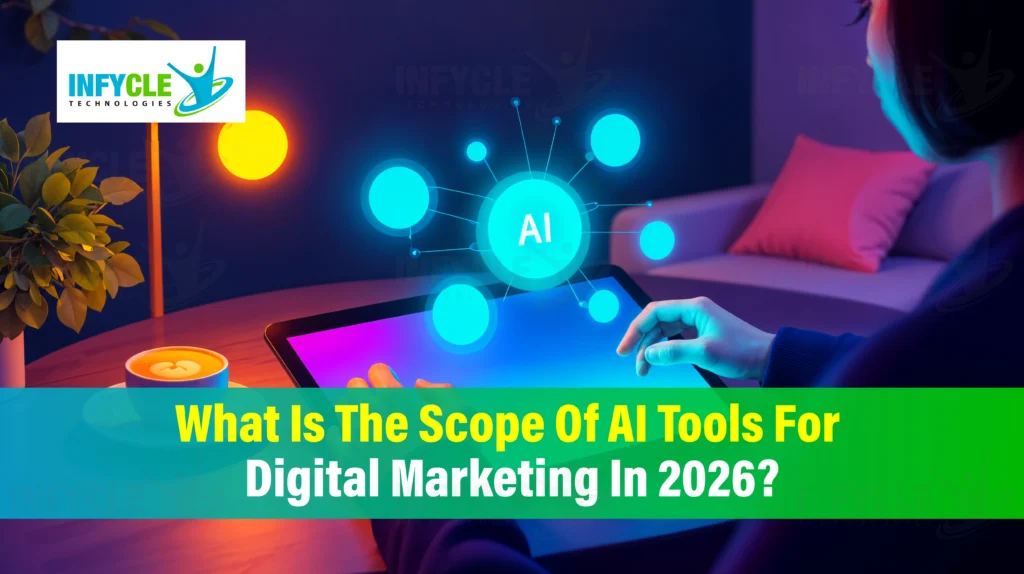
The digital marketing industry is experiencing a revolutionary transformation as it continues to evolve and integrate into every aspect of online business strategy. As we progress through 2026, the scope of AI tools for digital marketing in 2026 has made them indispensable assets for marketers seeking to optimize campaigns, understand customer behavior, and drive measurable results.
Today’s marketers need more than just a basic understanding of AI concepts—they must know how to apply these technologies in real-world marketing scenarios to boost campaign performance and achieve measurable results in a highly competitive digital environment.
AI-Powered Content Creation and Optimization
Content remains the foundation of digital marketing, and AI has fundamentally changed how marketers create, distribute, and optimize content across platforms. Advanced AI writing assistants now generate high-quality blog posts, social media content, email campaigns, and product descriptions with remarkable accuracy and creativity.
These tools analyze top-performing content, understand audience preferences, and suggest improvements in real time. Beyond simple text generation, AI platforms can now optimize content for search engines by identifying keyword opportunities, analyzing competitor strategies, and recommending structural improvements that enhance both readability and SEO performance. To gain practical knowledge and confidently implement these advanced methods, joining a Digital Marketing Course in Chennai allows professionals to work hands-on with AI-based content creation and real-time SEO strategies applied to marketing campaigns.
Video content creation has also been revolutionized through AI-powered editing tools that can automatically generate captions, suggest optimal posting times, and even create personalized video variations for different audience segments. Image generation and editing through AI has opened new creative possibilities, allowing marketers to produce professional-quality visuals without extensive design expertise.
Content calendars are now managed by intelligent systems that analyze performance metrics and automatically adjust publishing schedules to maximize engagement. The integration of AI into content workflows has significantly reduced production time while simultaneously improving quality and relevance, enabling marketing teams to scale their output without proportionally increasing resources or budgets.
Predictive Analytics And Customer Behavior Insights
AI-driven predictive analytics has revolutionized the understanding of customer behavior through sophisticated machine learning algorithms that analyze vast datasets and identify patterns invisible to manual analysis. Key capabilities include:
- Predict customer lifetime value and churn rates with remarkable accuracy to prioritize high-value relationships.
- Anticipate customer needs proactively by identifying pain points before customers recognize them.
- Aggregate multi-touchpoint data from websites, emails, social media, and purchases into comprehensive customer profiles
- Optimize budget allocation by focusing resources on high-conversion opportunities while eliminating waste.
- Advanced attribution modeling reveals which channels and touchpoints drive the most conversions.
- Real-time campaign adjustments based on emerging trends and shifting behaviors keep marketing relevant and effective.
Personalization At Scale Through AI
Customization has evolved from a competitive advantage to a customer expectation, and AI enables the delivery of customized experiences to millions of users simultaneously. Dynamic content engines powered by AI can modify website layouts, product recommendations, email content, and advertising messages based on individual user preferences, browsing behavior, and demographic information.
To start with, e-commerce platforms now use sophisticated recommendation algorithms that analyze customer purchase patterns. Consequently, these systems suggest products with remarkable accuracy. Ultimately, this significantly boosts conversion rates and increases average order values.
Email marketing has been transformed by AI-powered segmentation and personalization, in which messages are automatically customized based on subscriber behavior, engagement history, and predicted interests. Subject lines are optimized through machine learning models that test thousands of variations to identify the most effective messaging for each audience segment.
To begin with, AI-powered chatbots and virtual assistants provide personalized assistance to customers around the clock. Consequently, they answer questions, guide purchases, and resolve issues through increasingly human-like interactions. Ultimately, this enhances customer satisfaction while significantly reducing operational costs.
The level of personalization achievable through AI extends to pricing strategies, with dynamic pricing algorithms adjusting offers based on demand, competition, and individual customer propensity to purchase.
AI In Advertising And Campaign Management
The advertising ecosystem has been completely reimagined through artificial intelligence, enabling marketers to create more effective campaigns with greater efficiency. Advertising platforms powered by AI automatically adjust ad placements, bidding tactics, and creative content across channels to enhance ROI.
Programmatic advertising now leverages real-time data analysis to serve ads to the right person at the right time on the right platform, dramatically improving campaign performance. For those seeking to master advanced advertising techniques and AI-driven marketing strategies, Training at the Best Software Training Institute in Chennai offers in-depth programs that teach the latest tools and techniques used by top industry professionals.
Creative optimization has also benefited immensely from AI, with systems automatically testing thousands of ad variations—different headlines, images, calls to action, and formats—to identify winning combinations that resonate most effectively with target audiences. Budget allocation becomes more intelligent as AI algorithms continuously analyze campaign performance and automatically shift spending toward the highest-performing channels and audience segments.
Audience targeting has reached new levels of precision through lookalike modeling and behavioral clustering, identifying potential customers who share characteristics with existing high-value clients. Fraud detection powered by AI protects advertising budgets by identifying and blocking invalid clicks and impressions, ensuring marketing dollars are spent reaching genuine potential customers rather than bots or fraudulent sources.
Voice Search And Conversational AI
Voice search optimization is now a vital part of digital marketing as voice assistants and smart devices become widely used in both personal and professional settings. Advances in AI-driven voice recognition have reached near-human levels of accuracy, reshaping how people look for information and influence their buying choices.
Consequently, marketers must now optimize content for conversational queries, which differ significantly from traditional text-based searches. Moreover, they need to focus on natural language patterns and question-based keywords. Featured snippets and local search optimization have become increasingly important as voice searches often prioritize immediate, concise answers and location-based results.
Conversational AI extends beyond voice search into sophisticated chatbot interactions that can qualify leads, provide product recommendations, schedule appointments, and complete transactions entirely through natural dialogue. To begin with, these systems learn from every interaction to refine their understanding over time. Consequently, they improve their ability to grasp context and detect sentiment more accurately. Ultimately, this enables them to deliver genuinely helpful responses instead of robotic, scripted ones.
The integration of conversational AI into customer service workflows has transformed how brands handle support inquiries, with intelligent routing systems directing complex issues to human agents while automatically resolving routine questions. Voice-activated shopping experiences are becoming more sophisticated, allowing customers to use simple voice commands to add products to their carts, track order status, and finalize their purchases.
Social Media Management And Sentiment Analysis
AI tools are revolutionizing social media marketing by automating scheduling, engagement, and performance analysis. These technologies help brands connect with their audience more effectively and make data-driven decisions.
Key highlights include:
- Optimal scheduling: AI predicts the best posting times for maximum engagement
- Sentiment analysis: According to Planable.io brands can monitor public perception in real time and address potential issues proactively.
- Influencer identification: AI analyzes engagement and demographics for better partnerships
- Automated responses: Handle common customer queries while maintaining brand voice
- Content prediction: Forecast which posts will perform best before publishing
- Visual analysis: Understand product visibility and trends in user-generated content
Marketing Automation And Customer Journey Orchestration
Marketing automation has evolved dramatically through AI integration, moving beyond simple email workflows to sophisticated customer journey orchestration across all digital touchpoints. Intelligent automation platforms can now manage complex, Cross-channel campaigns that dynamically respond in real time to customer behavior and interactions.
Lead scoring has become more accurate through machine learning models that continuously refine qualification criteria based on conversion patterns and customer characteristics. Automated nurturing adapts content and timing in real time, delivering the right message at the right moment.
Cross-channel coordination powered by AI ensures consistent messaging and seamless experiences as customers move between email, social media, websites, and mobile apps. Trigger-based campaigns automatically activate when specific conditions are met, enabling timely, relevant communications that drive engagement and conversions.
Firstly, the integration of AI into marketing automation has significantly reduced manual tasks. As a result, marketing teams can focus more on strategy and creativity. Meanwhile, intelligent systems handle execution and optimization efficiently. Performance monitoring and reporting have become more sophisticated, with AI-generated insights highlighting opportunities and identifying underperforming elements that require attention.
The Future Trajectory Of AI In Marketing
As we look beyond 2026, the integration of artificial intelligence in digital marketing will only deepen and expand. Emerging technologies like generative AI, augmented reality, and advanced computer vision will create new possibilities for immersive brand experiences and interactive marketing campaigns.
Ethical AI use requires marketers to address data privacy, algorithmic bias, and transparency. Balancing innovation with responsible practices is essential to maintain consumer trust. Key areas poised for significant advancement include:
- Hyper-personalized omnichannel experiences that seamlessly adapt across devices and platforms based on real-time context and user intent
- Autonomous marketing systems capable of managing entire campaigns with minimal human intervention, from strategy development through execution and optimization
- Moreover, enhanced predictive modeling anticipates market shifts and consumer trends with increasing accuracy. As a result, marketers can adopt proactive strategies instead of reactive approaches.
- Advanced visual recognition allows brands to understand how their products appear in user-generated content and real-world environments
- Emotional AI that detects and responds to customer emotions through voice tone, facial expressions, and language patterns for more empathetic interactions
- Blockchain integration for transparent ad verification and secure customer data management
- Quantum computing applications that will exponentially increase processing capabilities for complex marketing analytics
Why Infycle Technologies Is A Smart Choice
Infycle Technologies is a strong choice for learners who want practical, career-focused training aligned with current industry demands. The institute emphasizes hands-on learning, real-time projects, and expert mentorship to help students gain job-ready skills.
Infycle Technologies offers updated course content, personalized guidance, and a strong focus on real-world applications. This approach helps learners build confidence, enhance performance, and stay competitive in today’s fast-evolving IT and digital marketing landscape.