What Is Oracle Data Integrator (ODI)? Architecture, Features, ETL Process & Career Scope
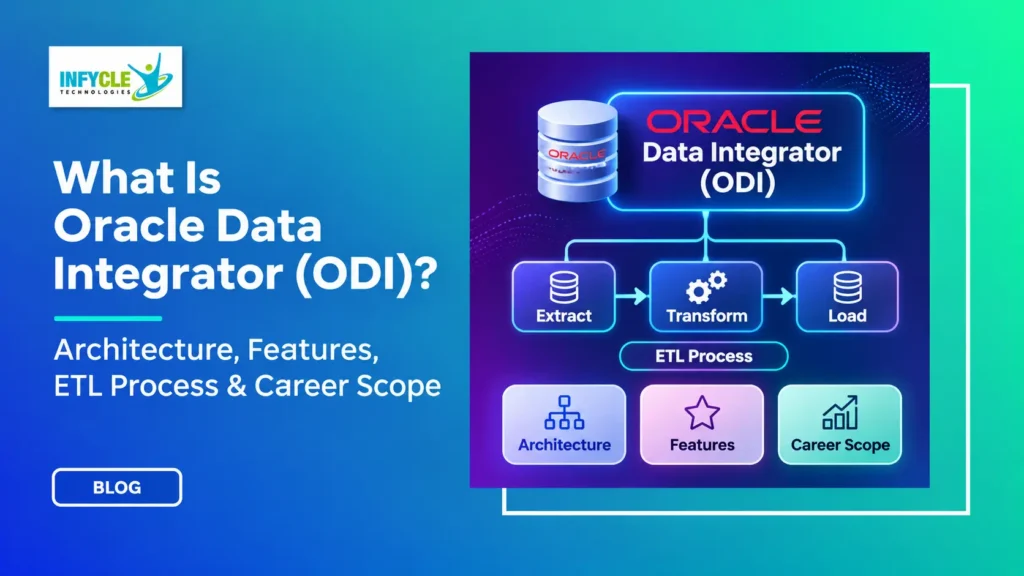
Oracle Data Integrator (ODI) is a powerful data integration platform used to move, transform, and manage data across multiple systems. It helps businesses automate ETL and ELT workflows while maintaining data quality and consistency.
Organizations use Oracle Data Integrator to connect databases, applications, data warehouses, and cloud platforms. Therefore, ODI plays an important role in business intelligence, data analytics, enterprise reporting, and data management.
For students, fresh graduates, and IT professionals, learning Oracle Data Integrator can open career opportunities in data engineering, ETL development, Oracle technologies, and enterprise data management. Moreover, understanding ODI architecture and integration workflows helps learners build practical skills for Oracle Data Integratorreal-world IT projects.
If you are exploring an Oracle course in Chennai, understanding Oracle Data Integrator is a valuable step toward building a career in Oracle and data technologies. With structured learning, practical exercises, and project exposure, beginners can gradually develop the skills needed to work with enterprise data systems.
In this guide, you will learn what Oracle Data Integrator is, how its architecture works, its key features, the ETL process, real-world applications, and career opportunities.
Table of Contents
- What Is Oracle Data Integrator (ODI)?
- How Does ODI Work?
- What Is Oracle Data Integrator Architecture?
- What Are the Key Features of Oracle ODI?
- How Does the ODI ETL Process Work?
- What Is the Difference Between ETL and ELT?
- Where Is Oracle Data Integrator Used?
- What Skills Are Required to Learn ODI?
- What Are the Career Opportunities After Learning ODI?
- Self-Learning vs Structured Oracle Training
- Frequently Asked Questions
- Conclusion
What Is Oracle Data Integrator (ODI)?
Oracle Data Integrator (ODI) is an enterprise data integration tool that transfers and transforms data between different systems. It supports data migration, data synchronization, data warehousing, and automated data processing.
Unlike traditional ETL tools, ODI often uses the database’s processing power to execute transformations. Therefore, it can handle large data volumes efficiently when properly designed.
For example, a company may collect sales data from multiple branches. ODI can extract the data, clean records, combine information, and load it into a central data warehouse.
Why Do Businesses Use Oracle Data Integrator?
Businesses use Oracle Data Integrator to simplify complex data workflows. Furthermore, it reduces manual data processing and improves consistency.
Common business applications include:
- Integrating data from multiple databases.
- Automating daily data loading processes.
- Synchronizing data between business applications.
- Preparing data for reporting and analytics.
- Migrating data from legacy systems.
- Building enterprise data warehouse pipelines.
As a result, organizations can make faster, more informed decisions using reliable data.
How Does Oracle Data Integrator Work?
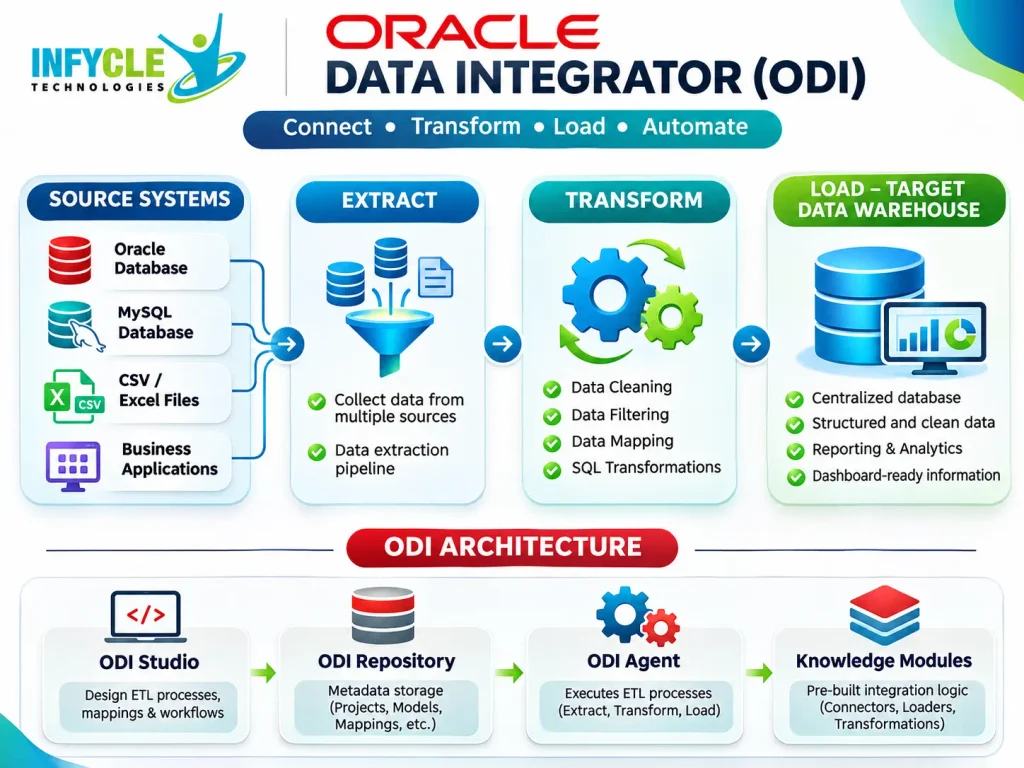
Oracle Data Integrator works by connecting source and target systems, defining data mappings, and executing integration workflows. It uses knowledge modules to manage different integration strategies.
The ODI workflow generally follows these steps:
- Connect to source systems: ODI connects to databases, files, applications, or other data sources.
- Extract data: It reads the required records from the source system.
- Transform data: It applies business rules, filtering, joins, calculations, and data cleansing.
- Load data: It writes processed data into the target database or warehouse.
- Monitor execution: It tracks job status, errors, logs, and performance.
Moreover, ODI can schedule recurring integration tasks. Therefore, companies can automate data processing without manually running every workflow.
What Is Oracle Data Integrator Architecture?
Oracle Data Integrator architecture consists of components that help developers design, execute, monitor, and manage data integration processes. Its architecture separates design activities from runtime execution.
What Are the Main Components of ODI Architecture?
| Component | Purpose |
|---|---|
| ODI Studio | Design and develop data integration projects |
| Repository | Stores metadata, projects, mappings, scenarios, and configuration |
| Designer | Develops integration interfaces and workflows |
| Operator | Monitors executions and reviews logs |
| Agent | Executes integration jobs and scheduled processes |
| Knowledge Modules | Defines how data is extracted, transformed, and loaded |
1. ODI Studio
ODI Studio is the development environment used to create integration projects. Developers use it to design mappings, procedures, packages, and workflows.
Furthermore, it helps manage reusable integration components.
2. Repository
The repository stores project metadata, connection details, mappings, scenarios, and execution information.
ODI commonly uses two repository types:
- Master Repository: Stores security information, topology, user details, and global configuration.
- Work Repository: Stores project-specific development objects, models, mappings, and execution metadata.
3. ODI Agent
An ODI Agent executes integration tasks. It processes scheduled jobs, runs scenarios, and coordinates data integration activities.
Depending on the architecture, developers may use standalone agents or Java EE agents.
4. Knowledge Modules (KMs)
Knowledge Modules are reusable templates that define integration operations. For instance, a Knowledge Module can determine how ODI extracts source data or loads data into a target database.
Therefore, KMs help developers customize integration behavior for different technologies.
What Are the Key Features of Oracle Data Integrator?
Oracle Data Integrator offers features that simplify enterprise data integration and automation. Moreover, these capabilities help organizations manage complex data pipelines.
Important Oracle ODI Features
- ELT architecture: Uses target database processing capabilities for transformations.
- Knowledge Modules: Provides reusable integration templates.
- Data transformation: Supports SQL-based transformations, joins, filters, and business rules.
- Workflow automation: Automates repetitive integration jobs.
- Scheduling: Executes tasks at defined times and intervals.
- Error handling: Helps identify failed jobs and troubleshoot issues.
- Monitoring: Tracks execution logs, sessions, and job performance.
- Connectivity: Supports integration across multiple database technologies and platforms.
Additionally, ODI supports reusable components. Consequently, developers can reduce development time when building similar data pipelines.
How Does the Oracle Data Integrator ETL Process Work?
The Oracle Data Integrator ETL process involves extracting data from source systems, transforming it according to business rules, and loading it into target systems.
Step 1: Extract Data
ODI retrieves data from source systems such as Oracle databases, SQL databases, flat files, or other supported technologies.
For example, a retail company may extract customer information, order details, and product data from separate systems.
Step 2: Transform Data
Next, ODI processes the extracted data using business rules. These transformations may include:
- Removing duplicate records.
- Converting data formats.
- Combining data from multiple tables.
- Calculating totals and averages.
- Filtering invalid records.
- Applying business logic.
Therefore, transformation helps prepare accurate and meaningful data.
Step 3: Load Data
Finally, ODI loads the transformed data into a target database, data warehouse, or other destination.
For instance, a company can load daily sales data into a reporting database. As a result, business teams can generate reports and analyze performance.
Step 4: Automate and Monitor
ODI can schedule integration jobs and monitor their execution. Moreover, developers can review logs, identify errors, and rerun failed processes when necessary.
This automation helps businesses maintain consistent data updates.
What Is the Difference Between ETL and ELT?
ETL and ELT are two approaches to data integration. The main difference is where the transformation process takes place.
| Feature | ETL | ELT |
|---|---|---|
| Full form | Extract, Transform, Load | Extract, Load, Transform |
| Transformation location | Before loading | After loading |
| Processing | ETL tool or processing engine | Target database or warehouse |
| Suitable for | Traditional data pipelines | Modern data platforms |
| Workflow | Extract → Transform → Load | Extract → Load → Transform |
ODI supports ELT-style processing in many integration scenarios. Instead of performing every transformation outside the target system, it can generate SQL and leverage the database engine.
Consequently, ELT can improve performance by using the processing power of the target database, depending on the data and system architecture.
Where Is Oracle Data Integrator Used?
Oracle Data Integrator is used across industries that depend on reliable data integration, automation, and reporting. Moreover, it helps organizations connect different systems and maintain centralized data.
Common ODI Use Cases
Banking and finance: Banks integrate customer data, transaction records, financial reporting information, and risk-related data.
Retail and e-commerce: Retailers consolidate sales, inventory, product, and customer information from different platforms.
Healthcare: Healthcare organizations integrate patient, operational, and administrative datasets across systems.
Telecommunications: Telecom companies process billing, customer activity, network, and service information.
Business intelligence: Companies prepare consolidated datasets for dashboards, reports, and analytics platforms.
For example, a Chennai-based company with multiple business branches can use ODI to consolidate daily sales records into a centralized reporting database. Consequently, management can analyze branch performance more easily.
What Skills Are Required to Learn Oracle Data Integrator?
Beginners can learn ODI without extensive prior experience. However, understanding databases and SQL makes the learning process much easier.
Essential Skills for ODI Beginners
| Skill | Why It Matters |
|---|---|
| SQL | Query, filter, join, and transform data |
| Database concepts | Understand tables, schemas, keys, and relationships |
| Data warehousing | Learn facts, dimensions, and warehouse concepts |
| ETL fundamentals | Understand data extraction, transformation, and loading |
| Oracle Database | Work with Oracle database environments |
| ODI architecture | Understand repositories, agents, and Knowledge Modules |
| Troubleshooting | Identify integration errors and performance issues |
Furthermore, hands-on practice is important. Reading documentation alone may not prepare you for real integration tasks.
Start with SQL fundamentals. Next, learn database concepts and ETL workflows. Finally, practice ODI mappings, packages, scenarios, and monitoring.
What Are the Career Opportunities After Learning Oracle Data Integrator?
Oracle Data Integrator skills can support careers in enterprise data management, database development, ETL, and data engineering. However, job opportunities depend on practical skills, experience, project knowledge, and employer requirements.
Oracle ODI Career Roles
- ETL Developer
- Data Integration Developer
- Oracle Developer
- Data Warehouse Developer
- Junior Data Engineer
- Database Developer
- Business Intelligence Developer
What Does an ODI Developer Do?
An ODI Developer creates and maintains data integration workflows. In addition, the developer connects databases, builds mappings, implements transformations, schedules jobs, and monitors integration processes.
Typical responsibilities include:
- Developing data integration mappings.
- Writing SQL queries.
- Building reusable workflows.
- Automating data loading processes.
- Monitoring ODI jobs.
- Troubleshooting failed executions.
- Supporting data migration projects.
For freshers, learning SQL, Oracle Database, ETL fundamentals, and ODI together can provide a stronger foundation than studying ODI alone.
Oracle Data Integrator vs Other Data Integration Tools
Oracle Data Integrator focuses on enterprise data integration, especially environments that use Oracle databases and related enterprise technologies. However, organizations may also use other integration tools based on their technology stack.
| Tool | Main Purpose |
|---|---|
| Oracle Data Integrator (ODI) | Enterprise data integration and ELT |
| Informatica | Enterprise ETL and data integration |
| Talend | Data integration and pipeline development |
| Apache Airflow | Workflow orchestration and scheduling |
| Azure Data Factory | Cloud-based data integration |
| SSIS | Microsoft SQL Server ETL |
Although these tools share similar goals, their architecture, connectivity, deployment, and learning requirements differ.
Therefore, learners should choose a tool based on the target job role, company environment, and long-term career goals.
How Can Beginners Learn Oracle Data Integrator?
Beginners should follow a structured learning path that combines database fundamentals, SQL, ETL concepts, ODI architecture, and practical projects.
Oracle Data Integrator Learning Roadmap
1: Learn SQL fundamentals
- SELECT statements
- WHERE conditions
- ORDER BY
- GROUP BY
- Joins
- Subqueries
- Functions
2: Understand Oracle Database
- Tables and schemas
- Primary and foreign keys
- Views
- Constraints
- Database relationships
3: Learn ETL and Data Warehousing
- ETL concepts
- Data pipelines
- Fact and dimension tables
- Data cleaning
- Data migration
4: Learn ODI Architecture
- ODI Studio
- Repositories
- Agents
- Topology
- Knowledge Modules
5: Practice ODI Development
- Create models and datastores
- Build mappings
- Configure transformations
- Create packages
- Generate scenarios
- Schedule jobs
- Monitor execution
6: Build Practical Projects
Finally, develop sample integration projects using real-world business scenarios. For instance, create a sales data pipeline that integrates customer, product, and transaction information into a reporting database.
This approach helps learners connect theoretical concepts with practical development skills.
Self-Learning vs Structured Oracle Training
Both self-learning and structured training can help you learn Oracle Data Integrator. However, the right method depends on your learning style, technical background, and access to practice environments.
| Factor | Self-Learning | Structured Training |
|---|---|---|
| Learning pace | Flexible | Guided |
| Mentor support | Limited | Available |
| Practical exercises | Self-organized | Trainer-guided |
| Doubt clarification | Independent research | Direct assistance |
| Project guidance | Requires planning | Structured project support |
| Learning path | Self-designed | Organized curriculum |
| Accountability | Self-managed | Scheduled sessions |
For beginners, structured learning can simplify difficult concepts. Moreover, practical assignments and trainer guidance can help learners identify mistakes faster.
On the other hand, self-learning works well for motivated learners who can consistently practice and research technical problems.
Build Your Career with Practical Oracle Training
Looking to develop database, SQL, ETL, and Oracle technology skills? Explore structured learning with practical exercises, project guidance, and industry-focused training at Infycle Technologies, Chennai.
Learn. Practice. Build real technical skills.
Frequently Asked Questions About Oracle Data Integrator
1. What is Oracle Data Integrator used for?
Oracle Data Integrator is used to integrate data across different systems, databases, and applications. It supports ETL and ELT workflows, data migration, data synchronization, warehouse loading, and automated business data processing.
2. Is Oracle Data Integrator easy to learn for beginners?
Yes, beginners can learn ODI with a structured approach. However, SQL and database fundamentals make learning easier. Therefore, start with SQL queries, tables, joins, and ETL concepts before practicing ODI mappings and workflows.
3. Is Oracle Data Integrator an ETL tool?
Yes, Oracle Data Integrator is a data integration tool that supports ETL and ELT approaches. Moreover, it can leverage target database processing power to perform transformations, which makes it useful for enterprise data workflows.
4. What is the career scope of Oracle Data Integrator?
Oracle Data Integrator can support career paths such as ETL Developer, Oracle Developer, Data Integration Developer, Data Warehouse Developer, and Junior Data Engineer. Furthermore, SQL, database knowledge, and project experience can improve career readiness.
5. Where can I learn Oracle technologies in Chennai?
Students and job seekers can explore Oracle training in Chennai through institutes offering structured courses, SQL practice, database fundamentals, practical exercises, and project-based learning. Compare the syllabus, trainer experience, practical exposure, and support before choosing a course.
Conclusion
Oracle Data Integrator is an important enterprise data integration technology that helps organizations automate data movement, transformation, synchronization, and warehouse loading. Moreover, its architecture, Knowledge Modules, mappings, agents, and ELT capabilities make it useful for managing complex business data workflows.
For beginners, learning SQL, Oracle Database, ETL fundamentals, and Oracle Data Integrator together can create a strong foundation for a data-focused IT career. Therefore, consistent practice and real-world projects are essential for developing job-ready skills.
If you are searching for an Oracle course in Chennai, choose a learning program that combines database fundamentals, practical SQL, Oracle concepts, hands-on exercises, and career guidance. The right training approach can help you build confidence and prepare for entry-level opportunities in the IT industry.