What Is Online Reputation Management (ORM) in Digital Marketing? Strategies, Benefits & Examples
Introduction
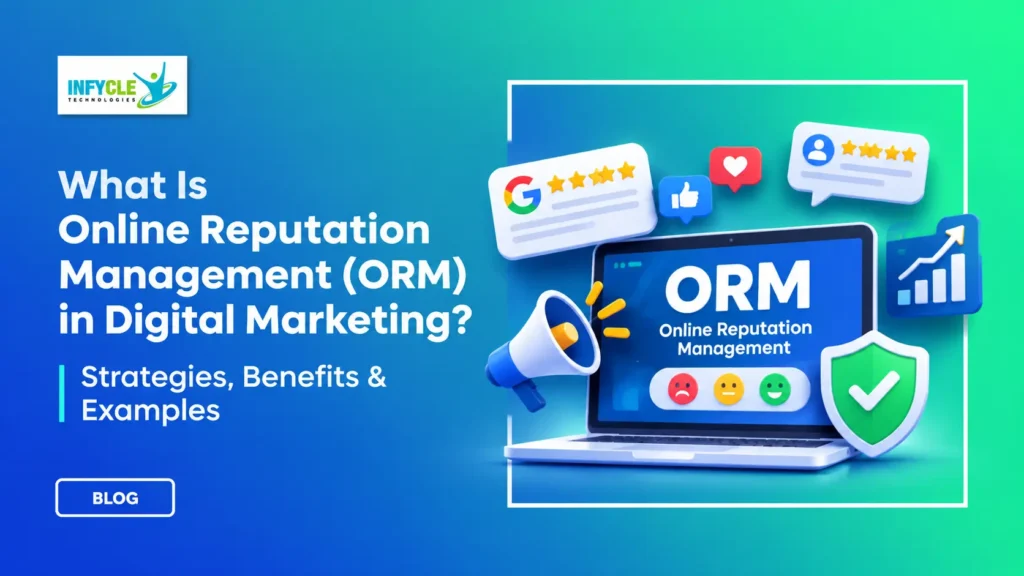
ORM in Digital Marketing refers to managing how people perceive a brand, business, or individual online. It focuses on building trust, maintaining a positive digital image, and responding to customer feedback across online platforms.
Today, customers often check Google reviews, social media comments, and ratings before choosing a business. Therefore, a company’s online reputation can directly influence customer decisions. A positive reputation attracts potential customers, while negative reviews can reduce trust and sales.
Moreover, Online Reputation Management (ORM) helps businesses monitor their online presence, respond to complaints, encourage genuine reviews, and improve customer satisfaction. For example, a restaurant with positive Google reviews may attract more visitors than a competitor with poor ratings.
ORM is an important part of digital marketing because it supports brand credibility, customer retention, and online visibility. In addition, businesses can use ORM strategies to understand customer expectations and improve their services.
For students, fresh graduates, and aspiring marketers, learning ORM is a valuable skill. It is also an important topic covered in a practical digital marketing course in Chennai, where learners explore SEO, social media, branding, analytics, and customer engagement.
Table of Contents
- What Is ORM in Digital Marketing?
- Why Is Online Reputation Management Important?
- How Does ORM Work?
- What Are the Key ORM Strategies?
- What Are the Benefits of ORM?
- ORM vs SEO vs SMM
- Real-World ORM Examples
- How Can Beginners Learn ORM?
- Frequently Asked Questions
- Conclusion
What Is ORM in Digital Marketing?
Online Reputation Management (ORM) is the process of monitoring, improving, and maintaining a brand’s reputation across the internet.
It includes managing customer reviews, social media mentions, search engine results, online discussions, and brand feedback. Furthermore, ORM helps businesses maintain transparency and build customer confidence.
What does ORM include?
- Google Business Profile reviews
- Social media comments and mentions
- Customer feedback and complaints
- Brand search results on Google
- Review platforms and directories
- Online PR and brand communication
Therefore, ORM helps businesses understand what customers say about them and respond appropriately.
Why Is ORM Important for Businesses?
ORM is important because customers trust online opinions when making purchasing decisions. As a result, businesses with a strong reputation can attract more leads and improve customer loyalty.
How does online reputation influence customers?
A positive online reputation can influence customers in several ways:
- Builds trust: Positive reviews make customers feel confident.
- Improves conversions: Customers are more likely to contact trusted businesses.
- Strengthens brand image: Consistent communication creates credibility.
- Supports local SEO: Reviews and customer engagement can support local search visibility.
- Improves customer experience: Feedback helps businesses identify service issues.
Moreover, businesses can use customer feedback to improve products, services, and communication.
How Does ORM Work in Digital Marketing?
ORM works through continuous monitoring, customer engagement, reputation analysis, and improvement. Businesses should not treat reputation management as a one-time activity.
What are the steps involved in ORM?
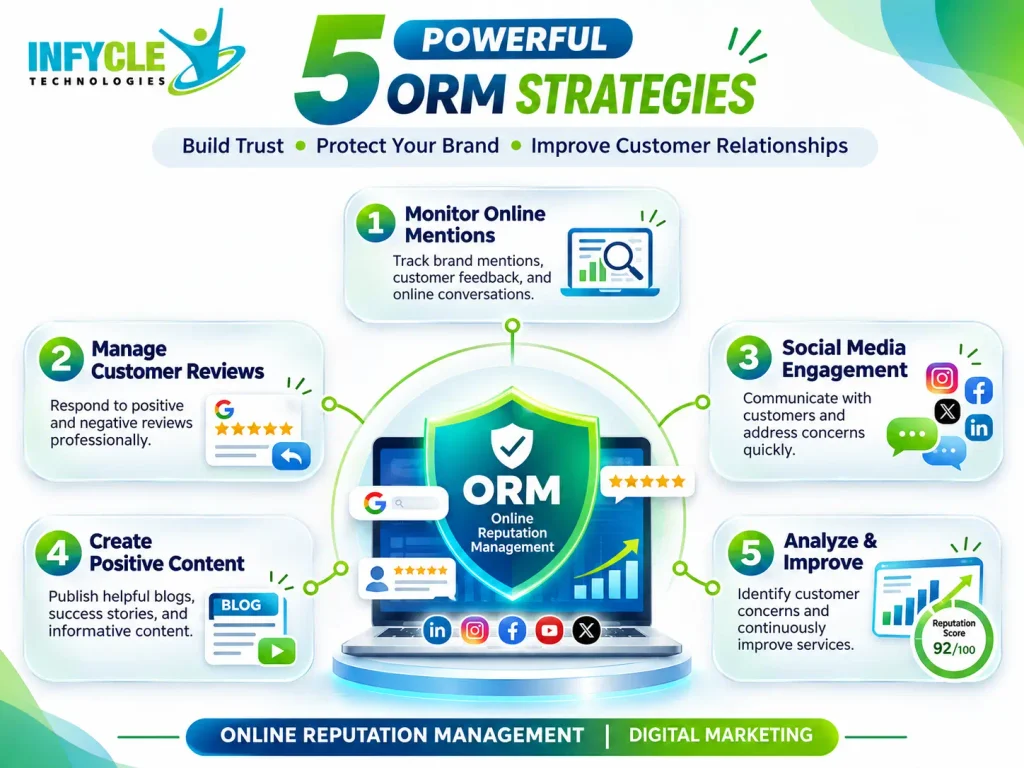
Step 1: Monitor online mentions
First, track customer reviews, social media comments, brand mentions, and business listings.
Step 2: Analyze customer feedback
Next, identify recurring complaints, positive experiences, and customer expectations.
Step 3: Respond professionally
Then, reply to reviews and customer queries politely. Address negative feedback without arguments.
Step 4: Encourage genuine reviews
Additionally, ask satisfied customers to share honest feedback. Never buy fake reviews or manipulate ratings.
Step 5: Improve business performance
Finally, use customer feedback to improve products, services, and support.
As a result, businesses can build a stronger online reputation over time.
What Are the Key ORM Strategies?
Effective ORM strategies help businesses maintain trust and handle online feedback professionally. However, each strategy must focus on genuine customer satisfaction.
1. How Does Review Management Improve Reputation?
Review management involves monitoring and responding to customer ratings and reviews on platforms such as Google.
For example, a business can thank customers for positive feedback and resolve issues mentioned in negative reviews. Therefore, customers feel heard and respected.
2. Why Is Social Media Monitoring Important?
Social media monitoring helps brands identify customer conversations across Instagram, Facebook, LinkedIn, and other platforms.
Furthermore, businesses can respond quickly to questions, complaints, and brand mentions. This approach helps prevent small issues from becoming larger reputation problems.
3. How Can SEO Support ORM?
Search Engine Optimization helps businesses improve the visibility of useful, trustworthy content in search results.
For instance, businesses can publish blogs, service pages, FAQs, and customer success stories. Consequently, customers can find accurate information about the brand more easily.
4. How Does Content Marketing Build Brand Trust?
Content marketing helps brands share valuable information instead of focusing only on promotions.
For example, educational blogs, videos, tutorials, and case studies demonstrate expertise. In addition, helpful content can answer customer questions and improve brand credibility.
5. How Can Businesses Handle Negative Reviews?
Businesses should respond to negative reviews calmly and professionally.
First, acknowledge the customer’s concern. Next, provide a solution or request further details privately. However, avoid blaming customers or sharing confidential information publicly.
What Are the Benefits of ORM?
Online Reputation Management offers several benefits for businesses, startups, educational institutions, and personal brands.
| Benefit | How It Helps |
|---|---|
| Brand trust | Builds confidence among potential customers |
| Customer loyalty | Encourages repeat purchases |
| Better conversions | Supports purchasing decisions |
| Customer insights | Reveals expectations and service issues |
| Local visibility | Supports local search presence |
| Brand credibility | Creates a professional online image |
Moreover, ORM helps businesses identify customer problems earlier. Therefore, they can improve their services before losing more customers.
ORM vs SEO vs SMM: What Is the Difference?
ORM, SEO, and SMM are related digital marketing activities. However, each has a different purpose.
| Activity | Main Purpose | Example |
|---|---|---|
| ORM | Build and protect online reputation | Responding to Google reviews |
| SEO | Improve organic search visibility | Ranking a website on Google |
| SMM | Promote a brand on social media | Instagram campaigns |
| SEM | Generate paid search traffic | Google Ads campaigns |
Although these strategies have different goals, they work better together. For example, SEO improves visibility, SMM creates engagement, and ORM builds trust.
What Are Real-World ORM Examples?
Businesses across different industries use ORM to improve customer relationships and brand credibility.
Example 1: Restaurant Reputation Management
A Chennai restaurant receives a negative review about delayed food delivery.
The manager responds politely, apologizes, and investigates the issue. Moreover, the restaurant improves its delivery process and requests honest feedback from customers.
As a result, the business demonstrates accountability and customer care.
Example 2: Software Training Institute ORM
A training institute receives feedback about course schedules and trainer communication.
The management responds to reviews, updates course information, and improves student support. Consequently, prospective students gain more confidence before enrolling.
Example 3: Personal Brand ORM
A job seeker maintains a professional LinkedIn profile, shares useful technical content, and participates in industry discussions.
Therefore, recruiters can discover the candidate’s skills, projects, and professional interests more easily.
How Can Beginners Learn ORM in Digital Marketing?
Beginners can learn ORM by understanding customer reviews, social media monitoring, SEO, brand communication, and analytics. Furthermore, practical exercises help students understand how businesses manage their online reputation.
What skills are required to learn ORM?
You do not need advanced technical knowledge to start learning ORM. However, basic digital marketing skills can help you work more effectively.
Important skills include:
- Google Business Profile management
- Review monitoring and response writing
- Social media management
- SEO fundamentals
- Content writing
- Customer communication
- Google Analytics basics
- Online brand monitoring
Additionally, learners should practice responding to positive, neutral, and negative customer reviews professionally.
How can students practice ORM?
Students can practice ORM using a sample business or a real brand’s public online presence.
For example, create a reputation audit that includes:
- Collecting customer reviews.
- Identifying positive and negative feedback.
- Analyzing common customer concerns.
- Preparing professional review responses.
- Suggesting reputation improvement strategies.
This practical activity helps students build a portfolio project for digital marketing interviews.
Where can you learn ORM in Chennai?
Students and fresh graduates can learn ORM as part of a practical digital marketing curriculum. A structured program helps learners understand SEO, social media, content marketing, Google Business Profile, paid advertising, and reputation management.
If you are searching for digital marketing training in Chennai, choose a program that includes live projects, industry tools, campaign analysis, and practical assignments rather than theory alone.
Learn Digital Marketing at Infycle Technologies
Build practical skills in SEO, social media marketing, Google Ads, content marketing, analytics, and Online Reputation Management.
Practical Training • Industry-Oriented Projects • Career Guidance
Self-Learning vs. Structured Digital Marketing Training
Both self-learning and structured training can help you develop digital marketing skills. However, the right choice depends on your learning style, career goals, and practical experience.
| Self-Learning | Structured Training |
|---|---|
| Learn through YouTube and blogs | Learn through a planned curriculum |
| Flexible learning schedule | Guided learning and mentorship |
| Practice depends on self-discipline | Practical assignments and projects |
| Limited feedback | Trainer feedback and support |
| Build skills independently | Develop skills through structured activities |
Therefore, beginners who need guidance and hands-on experience may benefit from structured training.
Frequently Asked Questions About ORM in Digital Marketing
1. What is ORM in Digital Marketing?
ORM in Digital Marketing is the process of managing a brand’s online reputation through reviews, social media, search results, and customer feedback. It helps businesses build trust, improve customer relationships, and maintain a positive digital image.
2. Why is Online Reputation Management important?
Online Reputation Management helps businesses maintain customer trust and credibility. Moreover, positive reviews can influence buying decisions, improve customer loyalty, and encourage potential customers to choose a brand over competitors.
3. Is ORM part of SEO?
ORM and SEO are related but different. SEO improves a website’s visibility in search engines, while ORM manages how people perceive a brand online. However, both strategies support online visibility, credibility, and business growth.
4. Which tools are used for Online Reputation Management?
Popular ORM tools include Google Business Profile, Google Alerts, Brand24, Mention, Hootsuite, and Sprout Social. Businesses use these platforms to monitor brand mentions, track reviews, analyze feedback, and manage customer interactions.
5. Can beginners learn ORM?
Yes, beginners can learn ORM without coding knowledge. They can start with review management, social media monitoring, customer communication, and Google Business Profile. Furthermore, practical digital marketing projects can help them gain confidence and job-ready skills.
Start Your Digital Marketing Career with Infycle Technologies
Digital marketing offers career opportunities across SEO, social media, content marketing, paid advertising, analytics, and ORM. Therefore, learning these skills can help students and fresh graduates explore different career paths.
At Infycle Technologies, Chennai, learners can develop practical digital marketing skills through structured training, hands-on assignments, and industry-oriented projects.
What will you learn in digital marketing training?
- Search Engine Optimization (SEO)
- Social Media Marketing (SMM)
- Google Ads and paid campaigns
- Content marketing and copywriting
- Online Reputation Management (ORM)
- Google Analytics and performance tracking
- Keyword research and competitor analysis
- Website optimization and lead generation
Moreover, practical training can help learners understand how businesses attract visitors, generate leads, and convert potential customers.
Want to build practical digital marketing skills?
Explore the Digital Marketing Course in Chennai at Infycle Technologies and learn how to work with real-world marketing tools, strategies, and projects.
Conclusion
Online Reputation Management is an important part of digital marketing because it helps businesses build trust, protect brand credibility, and improve customer relationships. By monitoring reviews, responding to feedback, creating useful content, and maintaining a positive online presence, businesses can strengthen their reputation.
Moreover, ORM works effectively alongside SEO, social media marketing, and content marketing. Therefore, businesses should treat reputation management as an ongoing process rather than a one-time task.
For students and fresh graduates, ORM is a valuable skill to develop. Learning it alongside SEO, social media, analytics, and advertising can improve career opportunities. If you want to enter this field, start exploring a practical digital marketing course in Chennai and build your skills through real projects.