Skills Required for Data Scientist in 2026

Data science is no longer limited to large tech companies or research labs. Businesses increasingly depend on data-driven decisions to remain competitive in a variety of industries, including banking, healthcare, e-commerce, and entertainment. That is why the demand for skilled data scientists continues to rise in 2026. For students and fresh graduates in Chennai, this career path has become one of the most promising opportunities in the technology industry. Whether you come from an engineering background, commerce stream, arts degree, or even a career break, learning the skills required for data scientist roles can open doors to high-paying and future-ready careers.
Companies are not just looking for people who can code. They want professionals who can understand business problems, analyze information, communicate insights, and make smart decisions using data. This shift has changed how companies hire data science professionals in 2026.
If you are planning to join a Data Science Training in Chennai, understanding both technical and non-technical skills will help you prepare better for the industry and stand out in interviews.
Why Data Science Skills Matter More Than Ever in 2026
According to recent industry reports, the global data science market is expected to grow rapidly over the next few years, with AI-powered analytics becoming a core business requirement. Organizations now collect huge volumes of customer, financial, and operational data daily.
But raw data alone is useless.
Businesses need professionals who can transform that data into meaningful insights. That is where data scientists play a major role. The modern data scientist acts as a combination of analyst, problem solver, communicator, and technology expert.
The skills required for data scientist positions are evolving because companies now expect professionals to work with AI tools, automation platforms, cloud systems, and real-time analytics environments.
Core Technical Skills Required for Data Scientist
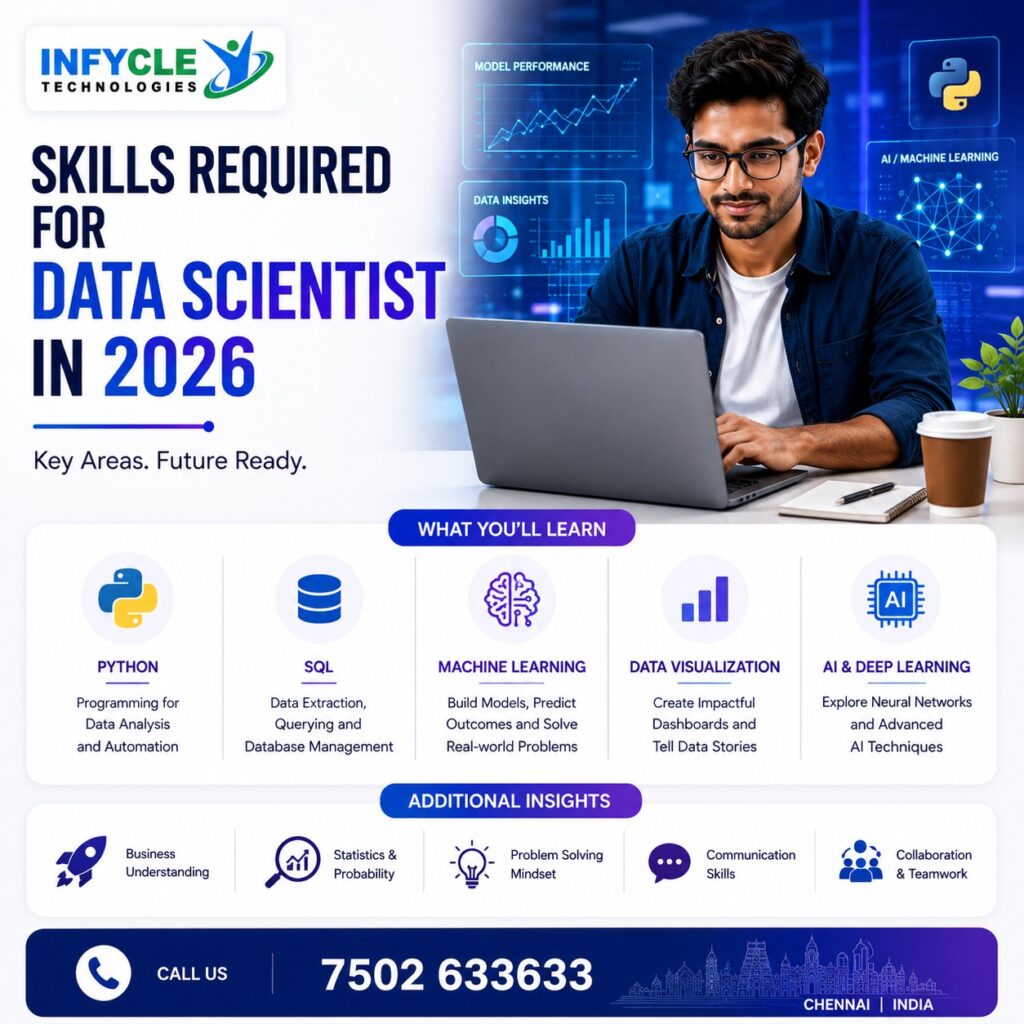
Technical knowledge forms the foundation of a successful data science career. Here are the most important skills employers expect in 2026.
1. Programming Skills
Programming is one of the most essential skills required for data scientist roles. The most commonly used programming languages are:
- Python
- R
- SQL
- Java
- Scala
Among these, Python remains the industry favorite because of its simplicity and powerful libraries.
Popular Python libraries include:
- Pandas
- NumPy
- TensorFlow
- Scikit-learn
- Matplotlib
Students learning through practical projects often gain confidence faster than those focusing only on theory.
2. Statistics and Mathematics
A data scientist works with patterns, predictions, probabilities, and trends. Without statistics, understanding data becomes difficult.
Important concepts include:
- Probability
- Linear algebra
- Regression
- Hypothesis testing
- Statistical modeling
You do not need to become a mathematician, but a strong understanding of basic concepts helps improve analytical thinking.
3. Data Visualization Skills
Data is valuable only when people can understand it clearly.
Companies prefer professionals who can present complex findings through dashboards and visual reports. Tools commonly used include:
- Tableau
- Power BI
- Google Data Studio
- Excel Advanced Analytics
Visualization helps business teams make faster decisions. It is one of the underrated yet highly valuable skills required for data scientist professionals today.
4. Machine Learning and AI Knowledge
Machine learning is becoming a standard requirement in many companies.
Data scientists are expected to build intelligent systems that can:
- Predict customer behavior
- Detect fraud
- Recommend products
- Automate decision-making
Popular machine learning concepts include:
- Supervised learning
- Unsupervised learning
- Neural networks
- Deep learning
- Natural Language Processing (NLP)
With AI adoption increasing in 2026, professionals with machine learning expertise are gaining a major salary advantage.
5. Database and SQL Skills
Every organization stores data in databases. A data scientist must know how to retrieve and manage data efficiently.
SQL is still one of the most requested technical skills in job postings.
Key areas include:
- Writing queries
- Data filtering
- Joins and relationships
- Data cleaning
- Database optimization
Even beginners from non-technical backgrounds can learn SQL quickly with practical training.
Non Technical Skills Required for Data Scientist Success
Technical expertise alone is not enough anymore. Companies increasingly value professionals who can collaborate, communicate, and think strategically.
Here are the non-technical skills employers look for.
1. Problem-Solving Ability
Businesses hire data scientists to solve real-world problems.
For example:
- Why are customers leaving a platform?
- Which products will sell next month?
- How can a company reduce operational costs?
A strong problem-solving mindset helps professionals identify practical solutions using data.
2. Communication Skills
One of the most important skills required for data scientist professionals is communication.
You may build a powerful model, but if you cannot explain the results clearly, decision-makers may not understand its value.
Good communication includes:
- Explaining insights simply
- Presenting reports confidently
- Storytelling with data
- Collaborating with teams
This skill becomes especially important during interviews and client meetings.
Looking to Build Job-Ready Data Science Skills?
Many students in Chennai are choosing practical-based learning instead of purely theoretical education. A structured training program with real-time projects, internship support, and mentorship can make the learning process smoother and more career-focused.
Choosing the right learning environment can help beginners understand industry tools faster and gain confidence before attending interviews.
3. Critical Thinking
Data scientists often deal with incomplete or confusing information. Critical thinking helps professionals:
- Analyze situations logically
- Ask the right questions
- Avoid incorrect conclusions
- Improve business decisions
This ability separates average professionals from highly valuable industry experts.
4. Curiosity and Continuous Learning
Technology changes rapidly.
In 2026, new AI tools, automation platforms, and analytics frameworks are emerging almost every month. Successful data scientists continuously upgrade their skills through:
- Online certifications
- Industry workshops
- Real-time projects
- Research and experimentation
A curious mindset is one of the most powerful long-term career advantages.
5. Team Collaboration
Data science projects involve multiple departments:
- Developers
- Marketing teams
- Business analysts
- Product managers
- Management teams
Collaboration skills help professionals work effectively in cross-functional environments.
Even freelancers and remote workers benefit from strong teamwork and communication habits.
Technical vs Non Technical Skills: Which Matters More?
This is one of the most common questions among beginners.
The truth is both are equally important.
Technical skills help you perform analysis and build solutions. Non-technical skills help you apply those solutions in real business environments.
For example:
- A candidate with strong coding skills but poor communication may struggle in client-facing roles.
- A candidate with excellent communication but weak analytical skills may fail technical interviews.
The ideal data scientist combines both abilities.
That is why many institutes offering the Best Software Training in Chennai now focus on project-based learning, presentation skills, and practical problem-solving rather than only classroom theory.
Career Opportunities After Learning Data Science
Once you master the skills required for data scientist careers, you can apply for multiple job roles such as:
- Data Scientist
- Data Analyst
- Machine Learning Engineer
- AI Specialist
- Business Intelligence Analyst
- Data Engineer
- Research Analyst
Industries hiring data professionals include:
- Banking
- Healthcare
- E-commerce
- Logistics
- IT services
- Digital marketing
- Manufacturing
Even startups in Chennai are actively hiring junior data professionals with practical knowledge.
How Beginners Can Start Learning Data Science
If you are an absolute beginner, follow this roadmap:
- Learn basic programming (Python)
- Understand statistics fundamentals
- Practice SQL queries
- Work on small data projects
- Learn visualization tools
- Build machine learning models
- Create a portfolio
Consistency matters more than perfection in the beginning.
Students from commerce, arts, and science backgrounds are successfully entering the field because modern training methods simplify the learning process.
FAQ Section
1. What are the most important skills required for data scientist jobs in 2026?
The most important skills include Python programming, machine learning, SQL, statistics, data visualization, communication skills, and problem-solving ability.
2. Can non-technical students learn data science?
Yes. Many students from commerce, arts, and science backgrounds successfully learn data science with structured practical training and beginner-friendly guidance.
3. Is coding mandatory for becoming a data scientist?
Basic coding knowledge is important, especially in Python and SQL. However, beginners can gradually learn coding through hands-on practice and projects.
4. How long does it take to learn data science?
For beginners, learning foundational data science skills may take around 6–12 months depending on practice, consistency, and project exposure.
5. Which tools should beginners learn first?
Beginners should start with:
- Python
- SQL
- Excel
- Power BI or Tableau
- Basic machine learning libraries
These tools provide a strong foundation for future growth.
Conclusion
Data science continues to be one of the most future-focused career paths in 2026. Cloud computing, to put it simply, is the use of the internet to store and access databases, services, and applications rather than local systems.
Whether you are a student, fresh graduate, freelancer, or career changer, building strong technical and interpersonal abilities can help you succeed in this growing industry. Enrolling in a practical-oriented data Science Course in Chennai can provide the right exposure, mentorship, and project experience needed to start your journey confidently.
If you are looking for industry-focused learning with hands-on projects and career guidance, Infycle Technologies offers practical training programs designed to help students build real-world expertise and prepare for modern tech careers.