How Is AI in Digital Marketing Changing Career Opportunities in 2026?
Introduction
For learners exploring technology careers in Chennai, understanding this shift has become more important than ever. Employers are no longer looking only for professionals who know how to manage social media accounts or run advertising campaigns. Instead, they seek individuals who can combine creativity, analytical thinking, and AI-powered tools to solve real business problems. This growing demand has made AI in Digital Marketing one of the most talked-about topics among aspiring marketers, fresh graduates, freelancers, and career changers.
Whether you’re from an Arts, Commerce, Science, or Engineering background, learning how AI supports modern marketing strategies can give you a competitive advantage. Rather than replacing human expertise, AI is reshaping job roles by automating repetitive tasks and allowing marketers to focus on strategic thinking, customer engagement, and business growth.
Why AI Is Becoming an Essential Part of Digital Marketing
Marketing has always been driven by understanding people. What has changed is the amount of data businesses now collect every day. Websites, mobile apps, search engines, and social media platforms generate enormous amounts of information that would be nearly impossible to analyze manually.
Artificial Intelligence helps marketers process this information faster, identify patterns, and make informed decisions.
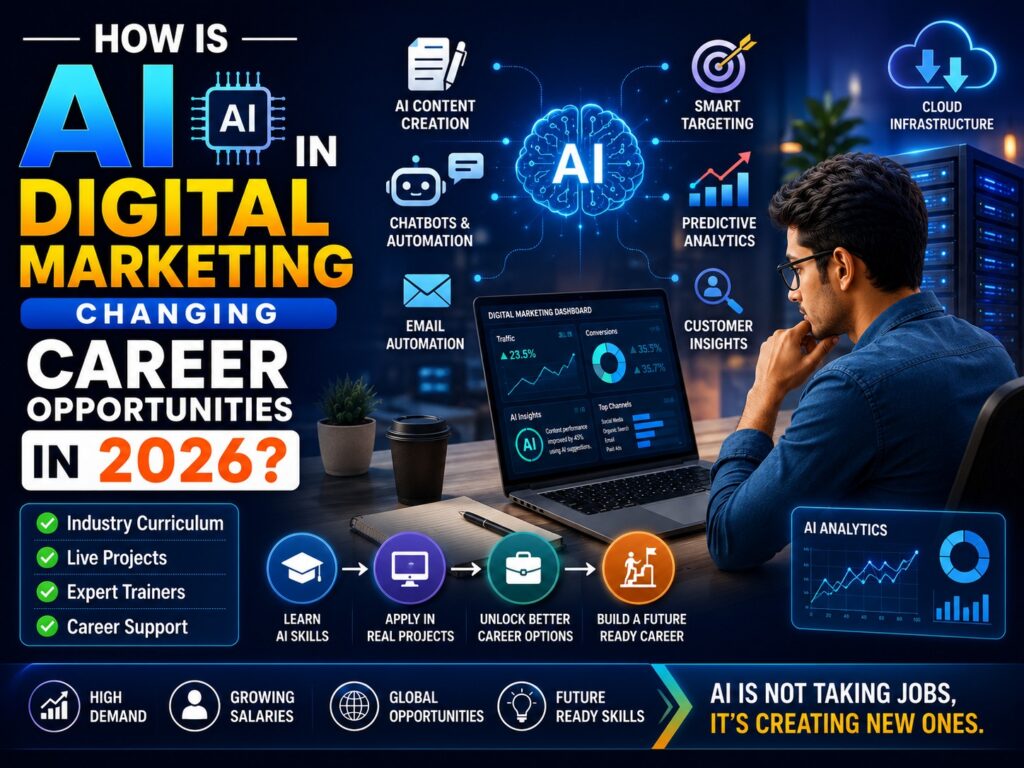
Today, AI is commonly used for:
- Keyword research and content planning
- Audience segmentation
- Customer behavior analysis
- Predictive analytics
- Marketing automation
- Chatbots and customer support
- Email personalization
- Campaign performance optimization
Instead of spending hours collecting reports or manually analyzing customer behavior, marketers can now use AI-powered platforms to gain actionable insights within minutes.
AI in Digital Marketing Is Creating New Career Roles
One of the biggest misconceptions is that AI will eliminate marketing jobs. Industry trends suggest a different picture.
As AI tools become more sophisticated, businesses need professionals who understand both marketing principles and AI technologies. Rather than replacing marketers, AI is changing the nature of their work.
Some emerging career opportunities include:
AI Marketing Specialist
These professionals use AI platforms to improve campaign performance, automate marketing workflows, and analyze customer data.
Marketing Automation Specialist
Businesses increasingly rely on automation tools to nurture leads, send personalized emails, and improve customer engagement.
Professionals with experience in automation platforms continue to be in demand across industries.
SEO Strategist with AI Expertise
Search engine optimization has evolved significantly.
Modern SEO professionals now use AI for:
- Keyword clustering
- Content optimization
- Competitor analysis
- Search intent research
- Technical SEO audits
Understanding how AI supports SEO helps marketers work more efficiently while maintaining content quality.
Content Strategist
Although AI can generate content drafts, businesses still need professionals who understand:
- Brand voice
- Audience psychology
- Search intent
- Storytelling
- Content planning
Human creativity continues to play a vital role in producing meaningful and trustworthy content.
Data-Driven Digital Marketing Analyst
Businesses increasingly make decisions based on marketing data.
Professionals capable of interpreting dashboards, campaign metrics, customer journeys, and conversion reports are becoming valuable members of marketing teams.
Which Skills Will Employers Expect in 2026?
Learning AI tools alone isn’t enough.
Employers typically look for candidates who combine technical knowledge with business understanding.
Some of the most valuable skills include:
Technical Skills
- Search Engine Optimization (SEO)
- Google Ads
- Meta Ads
- Google Analytics 4
- Google Search Console
- Content Marketing
- Email Marketing
- Marketing Automation
- AI Prompt Engineering
- Data Interpretation
Soft Skills
- Problem-solving
- Creativity
- Communication
- Critical thinking
- Adaptability
- Customer understanding
These skills help professionals make better marketing decisions rather than relying entirely on automation.
Popular AI Tools Every Digital Marketer Should Know
The marketing technology landscape continues to evolve rapidly.
Some of the widely used AI-powered tools include:
| Purpose | AI Tool Examples |
|---|---|
| Content Ideation | ChatGPT, Gemini |
| SEO Research | Semrush AI, Ahrefs AI features |
| Graphic Design | Canva AI |
| Image Generation | Adobe Firefly |
| Email Marketing | HubSpot AI |
| Video Creation | Synthesia |
| Automation | Zapier AI |
| Analytics | Google Analytics Intelligence |
Understanding when and how to use these tools responsibly is becoming an important workplace skill.
Human Creativity Still Matters
One of the most interesting developments is that businesses aren’t replacing creative professionals—they’re expecting them to work alongside AI.
For example:
An AI tool might generate five advertising headlines.
A skilled marketer chooses the one that best matches customer psychology.
Similarly,
AI may recommend keywords.
An experienced SEO specialist decides which keywords align with user intent and business goals.
This collaboration between human expertise and AI is shaping the future of marketing careers.
If you’re planning to build a future-ready marketing career, spend time learning both digital marketing fundamentals and AI-powered tools. A strong understanding of SEO, analytics, advertising platforms, and automation can help you adapt as the industry continues to evolve and open new career opportunities.
Why Students in Chennai Are Exploring AI-Driven Marketing Skills
As companies across Chennai continue investing in digital transformation, employers increasingly value candidates who understand both marketing strategy and modern AI tools. This shift has encouraged many students and working professionals to look beyond theoretical knowledge and focus on practical, job-ready skills.
Choosing a learning path that combines real-world projects with emerging technologies can help learners build confidence and stay aligned with changing industry expectations. Many learners researching a Digital Marketing Course in Chennai now compare institutes based on curriculum updates, hands-on experience, and exposure to AI-powered marketing platforms rather than certificates alone.
Future Trends: Where Is AI in Digital Marketing Heading Beyond 2026?
The next few years are expected to bring even greater collaboration between marketers and Artificial Intelligence. Instead of replacing professionals, AI will continue to automate repetitive tasks while giving marketers more time to focus on strategy, creativity, and customer relationships.
Several trends are already shaping the future of digital marketing:
Hyper-Personalized Customer Experiences
Consumers increasingly expect personalized recommendations, emails, advertisements, and website experiences. AI helps businesses analyze customer behavior and deliver content that matches individual interests, making marketing more relevant and engaging.
Voice and Visual Search Optimization
Search habits are changing rapidly.
People are now using voice assistants and image-based searches to find products and services. This means marketers will need to understand conversational keywords, structured data, and image optimization alongside traditional SEO techniques.
AI-Powered Predictive Marketing
Rather than reacting to customer behavior, businesses are beginning to predict future actions using AI.
For example, AI can help identify:
- Customers likely to make a purchase
- Products users may be interested in
- Best times to send marketing emails
- Potential customer churn
- High-converting audience segments
Professionals who understand predictive analytics are expected to become increasingly valuable.
Ethical AI and Responsible Marketing
As AI becomes more integrated into marketing, businesses are paying greater attention to transparency, privacy, and responsible AI usage.
Future digital marketers will need to understand:
- Customer data privacy
- Ethical content creation
- Responsible AI usage
- Copyright considerations
- Bias in AI-generated content
These skills are becoming just as important as technical expertise.
Common Myths About AI in Marketing
Technology often creates uncertainty, especially when new tools become widely adopted. Let’s address a few common misconceptions.
Myth 1: AI Will Replace Every Digital Marketer
The reality is more balanced.
AI can automate repetitive processes such as reporting, keyword suggestions, and content drafts, but strategic planning, storytelling, customer empathy, and creative decision-making still depend on human expertise.
Myth 2: Learning AI Means You Don’t Need Marketing Knowledge
AI is most effective when users understand marketing fundamentals.
Without knowledge of customer behavior, branding, SEO, advertising, and analytics, it’s difficult to use AI tools effectively.
Myth 3: Only Technical Professionals Can Learn AI Marketing
Many AI-powered marketing platforms are designed for non-programmers.
Students from Arts, Commerce, Science, Business, and Engineering backgrounds can learn these tools with proper guidance and consistent practice.
A Practical Roadmap for Beginners
If you’re wondering where to begin, following a structured learning path can make the process much easier.
Step 1: Understand Digital Marketing Fundamentals
Build a strong foundation by learning:
- SEO
- Social Media Marketing
- Google Ads
- Content Marketing
- Email Marketing
- Google Analytics
Step 2: Learn Popular AI Marketing Tools
Explore tools used by professionals for:
- Content creation
- Keyword research
- Graphic design
- Campaign optimization
- Customer insights
Understanding how these tools support marketing workflows can improve both productivity and decision-making.
Step 3: Practice Through Real Projects
Theory alone rarely builds confidence.
Working on live websites, creating marketing campaigns, analyzing traffic reports, and optimizing content helps learners understand how marketing strategies perform in real business environments.
Step 4: Build a Portfolio
Instead of collecting only certificates, showcase your practical work.
Your portfolio might include:
- SEO projects
- Blog content
- Social media campaigns
- Google Ads reports
- Website audits
- AI-assisted marketing strategies
A strong portfolio demonstrates practical skills and helps employers evaluate your capabilities.
Why Practical Learning Matters More Than Ever
As AI tools become easier to access, employers increasingly distinguish candidates based on how they apply technology rather than simply knowing about it.
For learners exploring a Digital Marketing Course in Chennai, practical experience with real-world projects, analytics tools, SEO strategies, and AI-assisted workflows can make a significant difference during interviews and on the job.
Many students also compare learning environments before enrolling. Along with curriculum and trainer experience, it’s worth considering whether the course includes exposure to current AI tools, live projects, and opportunities to solve realistic marketing challenges. Institutes such as Infycle Technologies are among those adapting their curriculum to reflect these evolving industry expectations, helping learners gain practical exposure alongside theoretical knowledge.
FAQ
1. Will AI in Digital Marketing replace traditional marketing jobs?
No. AI is changing how marketers work by automating repetitive tasks, but businesses still need professionals who can create strategies, understand customer behavior, analyze results, and make informed marketing decisions.
2. Which AI skills should beginners learn for a digital marketing career?
Beginners should focus on learning AI-assisted content creation, SEO research, marketing automation, analytics, prompt writing, and campaign optimization while also building strong marketing fundamentals.
3. Is coding required to work with AI marketing tools?
No. Most modern AI marketing platforms are designed with user-friendly interfaces that don’t require programming knowledge. Understanding marketing concepts is generally more important than coding for many digital marketing roles.
4. How can students prepare for AI-driven marketing careers?
Students should combine theoretical learning with practical experience by working on SEO projects, advertising campaigns, website analytics, and AI-powered marketing tools. Continuous learning is also essential because the industry evolves rapidly.
Conclusion
Artificial Intelligence is transforming digital marketing by improving efficiency, enhancing customer experiences, and supporting better decision-making. Rather than reducing career opportunities, it is creating new roles that combine technology with creativity, strategy, and analytical thinking. Professionals who continuously develop their skills, embrace emerging technologies, and gain practical experience will be well-positioned for long-term success.
If you’re planning to build these future-ready skills, choosing a Digital Marketing Course in Chennai that emphasizes practical learning, industry-relevant tools, and real-world projects can provide a strong foundation for your career journey.