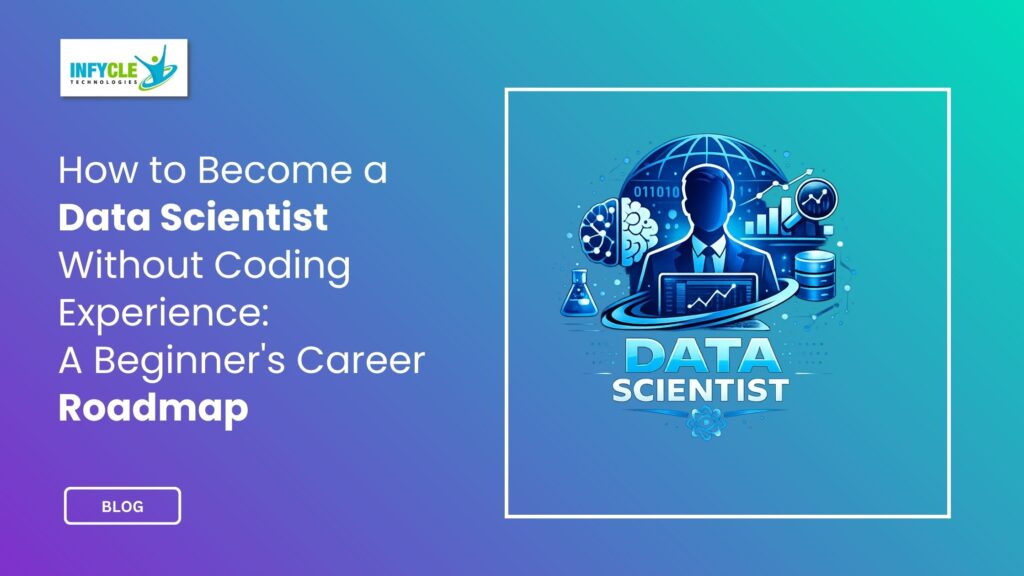
How to Become a Data Scientist Without Coding Experience: A Beginner’s Career Roadmap
If you’ve ever looked at a Data Science job description and immediately felt intimidated by the programming requirements, you’re not alone. Thousands of students, graduates, and career changers believe that coding expertise is mandatory before entering the field. The reality is quite different.
Many successful professionals started their journey as a Data Scientist Without Coding Experience, learning the necessary skills step by step rather than mastering everything upfront. With the rise of user-friendly analytics tools, no-code platforms, and structured learning programs, entering Data Science has become more accessible than ever.
For students and job seekers in CITY, this creates a valuable opportunity. Companies are increasingly hiring professionals who can interpret data, solve business problems, and communicate insights effectively. While coding remains useful, it is no longer the barrier it once was.
Whether you’re from an Arts, Commerce, Science, or Engineering background, this roadmap will help you understand how to transition into Data Science, what skills matter most, and how to build a career without feeling overwhelmed.
Why Data Science Is Still One of the Best Career Choices in 2026
Data has become the foundation of business decision-making. Organizations across healthcare, banking, retail, logistics, manufacturing, and technology rely on data to improve efficiency and identify growth opportunities.
Industry reports predict continued growth in analytics and AI-related roles throughout 2026 and beyond. Companies are not just looking for programmers; they are seeking professionals who can:
- Analyze business problems
- Understand patterns in data
- Create meaningful reports
- Support strategic decision-making
- Communicate insights to stakeholders
This means there is room for beginners, non-technical graduates, and aspiring professionals who are willing to learn systematically.
Step 1: Understand What a Data Scientist Actually Does
One of the biggest misconceptions is that Data Scientists spend all day writing code.
In reality, a large portion of the job involves:
- Understanding business requirements
- Collecting and organizing data
- Cleaning datasets
- Identifying trends
- Creating visual reports
- Presenting findings to decision-makers
A beginner aiming to become a Data Scientist Without Coding Experience should first focus on understanding the problem-solving aspect of the role rather than worrying about complex programming.
Think of Data Science as a combination of business understanding, analytical thinking, and technical skills.
Step 2: Build Strong Analytical Thinking Skills
Before learning any tools, develop your analytical mindset.
Ask questions such as:
- Why are sales increasing in one region?
- Why do customers stop purchasing?
- Which marketing campaigns generate better results?
- What factors influence business performance?
The ability to think critically often separates successful data professionals from those who only know technical tools.
Fortunately, analytical thinking can be developed through practice, case studies, and real-world business scenarios.
Step 3: Start with Excel and Data Visualization
Many beginners underestimate the importance of Excel.
Even today, Excel remains widely used for:
- Data cleaning
- Reporting
- Dashboard creation
- Business analysis
- Data visualization
Learning tools such as:
- Microsoft Excel
- Power BI
- Tableau
can help aspiring professionals gain confidence before moving into more advanced Data Science concepts.
For someone pursuing a career as a Data Scientist Without Coding Experience, visualization tools provide an excellent starting point because they make data easier to understand without requiring extensive programming knowledge.
Step 4: Learn Statistics Without Overcomplicating It
Statistics often sounds intimidating, but beginners only need to understand the fundamentals initially.
Focus on concepts such as:
- Mean, median, and mode
- Probability basics
- Correlation
- Data distribution
- Sampling techniques
These concepts help explain why certain trends appear in data and how predictions are made.
The goal is not to become a mathematician but to develop enough understanding to interpret results correctly.
Step 5: Learn Beginner-Friendly Python Gradually
Eventually, coding becomes valuable.
However, the key word is “eventually.”
A common mistake is trying to learn advanced programming before understanding Data Science fundamentals.
Instead, learn Python gradually:
- Variables and data types
- Loops and conditions
- Functions
- Data analysis libraries
- Basic automation
Many students pursuing Data Scientist Without Coding Experience career paths discover that coding becomes much easier after understanding the business side of data. Looking for structured guidance? A practical Data Science training in chennai can help you learn analytics, visualization, Python, Machine Learning, and real-world project implementation without feeling overwhelmed by technical complexity. Learning with experienced mentors often shortens the journey and helps beginners stay focused on industry-relevant skills.
Step 6: Work on Real Projects
Employers value practical experience more than theoretical knowledge.
Start building projects such as:
- Sales performance dashboards
- Customer behavior analysis
- Marketing campaign reports
- Product recommendation analysis
- Business forecasting models
Real projects help you understand how data is used in business environments and strengthen your portfolio.
Even simple projects demonstrate initiative and practical problem-solving ability.
Step 7: Learn Machine Learning Concepts
Machine Learning is often viewed as an advanced topic, but beginners should understand the fundamentals.
Focus on:
- What Machine Learning is
- Supervised learning
- Unsupervised learning
- Classification
- Prediction models
At this stage, understanding concepts matters more than building complex algorithms.
A future Data Scientist Without Coding Experience can begin by learning how Machine Learning solves real business challenges before diving deeper into technical implementation.
Step 8: Build a Portfolio and LinkedIn Presence
Your portfolio becomes proof of your capabilities.
Include:
- Data analysis projects
- Dashboards
- Visual reports
- Case studies
- Problem-solving examples
Additionally, maintain an active LinkedIn profile by:
- Sharing project insights
- Discussing industry trends
- Networking with professionals
- Following Data Science leaders
Recruiters often review portfolios and LinkedIn profiles before scheduling interviews.
Common Mistakes Beginners Should Avoid
Many aspiring Data Scientists slow their progress by making avoidable mistakes:
Trying to Learn Everything at Once
Focus on one skill at a time.
Ignoring Business Knowledge
Data Science is about solving business problems, not just technical execution.
Avoiding Projects
Projects help transform theoretical knowledge into practical experience.
Comparing Yourself to Experts
Every professional starts as a beginner.
Progress matters more than perfection.
What Does the Future Look Like?
The future of Data Science is expanding beyond traditional coding-heavy roles.
Emerging trends include:
- No-code analytics platforms
- AI-assisted data analysis
- Automated Machine Learning
- Business Intelligence integration
- Self-service analytics
These developments are creating more opportunities for beginners and non-technical professionals than ever before.
For learners in CITY, acquiring Data Science skills today could position them for some of the most exciting career opportunities of the next decade.
Frequently Asked Questions
Can I become a Data Scientist Without Coding Experience?
Yes. Many professionals begin by learning analytics, visualization, statistics, and business intelligence before gradually developing programming skills.
How long does it take to learn Data Science as a beginner?
Most beginners can build foundational knowledge within 4–8 months with consistent learning and project practice.
Is Data Science suitable for non-technical students?
Absolutely. Students from Arts, Commerce, Science, and other backgrounds can successfully transition into Data Science.
Do employers hire entry-level Data Science candidates?
Yes. Many organizations recruit junior analysts, business intelligence associates, and trainee Data Scientists with foundational skills and project experience.
Is coding mandatory for every Data Science role?
Not always. Several analytics and reporting roles focus more on business insights, visualization, and decision-making than advanced programming.
Conclusion
Building a successful Data Science career does not require you to be an expert programmer on day one. Start with analytical thinking, learn data visualization, understand statistics, work on practical projects, and gradually add technical skills over time.
If you’re serious about entering this growing field, enrolling in a quality Data Science training in chennai at Infycle Technologies can provide the structured learning, hands-on experience, and industry exposure needed to accelerate your career journey and become job-ready in today’s competitive market.