Will AI Replace Human Jobs? Why Learning AI Skills Are Essential in 2026
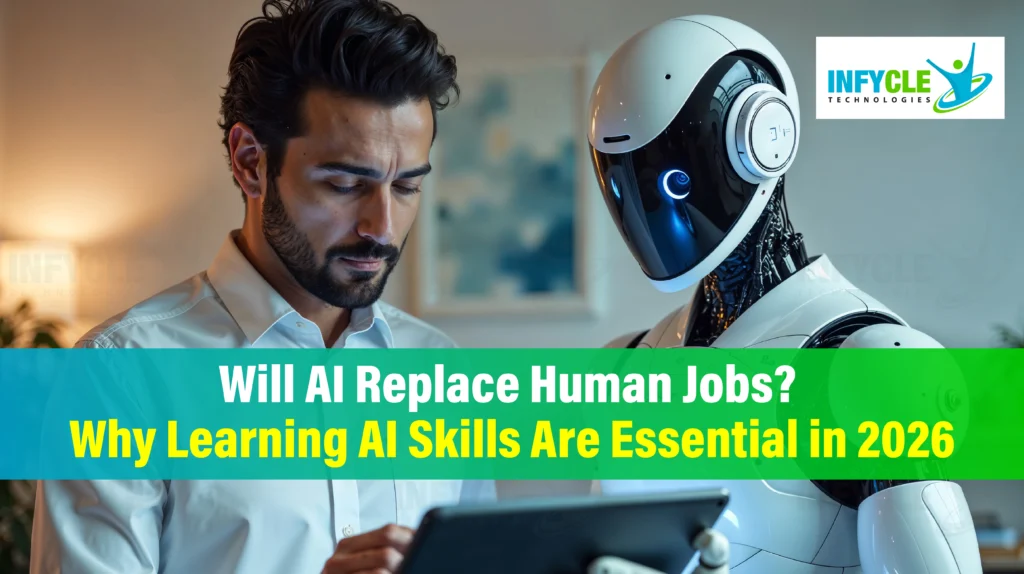
Artificial Intelligence (AI) has become the most transformative technology of our time, shaping how we work, communicate, learn, shop, and even make decisions. As we move into 2026, discussions around AI continue to intensify—especially the big question everyone is asking: Will AI replace human jobs? While AI is automating tasks faster than ever before, the truth is more nuanced. AI isn’t just eliminating jobs—it is reshaping industries and generating a massive wave of new opportunities.
Understanding this shift is crucial for students, professionals, career changers, and anyone who wants to stay relevant in the competitive job market. The future belongs to those who learn AI, use it effectively, and adapt to evolving workplace demands. Before diving deeper into why learning AI is essential, we must understand how AI is changing job roles, the types of jobs at risk, and the emerging careers that will dominate the future workforce.
In the early stages of the AI revolution, tech jobs alone seemed impacted. But by 2026, every industry—from finance, healthcare, and marketing to manufacturing, logistics, and education—has integrated AI into their workflows. Companies are demanding professionals who can work with AI tools, understand automation, interpret data, and use machine learning insights to make smart decisions. This is one reason people are now actively searching for the Best Software Training in Chennai to upgrade their skills and prepare for AI-driven roles.
Is AI Really Replacing Jobs? The Real Truth
The fear that “robots will take our jobs” isn’t new. Every technological revolution—from the invention of electricity to computers—triggered the same anxiety. But history shows that technology does not eliminate jobs entirely; instead, it transforms them.
Jobs AI Is Replacing
AI-powered automation is transforming the modern workforce by taking over jobs that involve repetitive manual tasks, basic customer support, routine administrative responsibilities, simple data entry, low-level analytics, reporting, and predictable manufacturing processes. These roles are becoming increasingly vulnerable because AI systems can perform them faster, more accurately, and at a significantly lower cost. As a result, traditional operational roles that rely heavily on repetition and predictable workflows are at the highest risk of being replaced.
Jobs AI Is Creating
While AI is replacing certain roles, it is also giving rise to an entirely new category of high-value careers. Some of the fastest-growing opportunities include AI Prompt Engineer, Machine Learning Developer, Data Analyst, Automation Test Engineer, AI-Assisted Digital Marketer, Cloud + AI Solutions Architect, Cybersecurity Analyst with AI capabilities, Data Science With AI expert, AI Project Manager, Robotics Process Automation (RPA) Specialist, and Business Analyst skilled in AI-powered tools. These emerging roles demonstrate that AI is not just eliminating jobs—it’s reshaping the workforce and creating exciting, future-ready career paths for those who upskill.
These jobs require a combination of human thinking and AI expertise. AI tools cannot replace human creativity, problem-solving, emotional intelligence, critical thinking, or decision-making. Instead, they amplify these strengths.
This is why more students and professionals are enrolling in courses related to Data Science With AI, machine learning, and automation to stay ahead of the competition.
Why Learning AI in 2026 Is Essential
AI is not optional anymore—it has become a baseline skill, just like how computers and the internet were once optional but eventually became essential.
Let’s explore why learning AI is now a necessity for career growth.
1. AI Skills Are in High Demand Across All Industries
The demand for AI-skilled professionals is increasing rapidly. Companies across every domain are integrating AI:
- Hospitals use AI for diagnostics and patient data analysis.
- Banks use AI for fraud detection and risk management.
- IT companies use AI for coding, automation testing, and DevOps.
- Marketing teams use AI for personalization, content creation, and analytics.
- Retail uses AI to track inventory, forecast demand, and automate logistics.
This massive adoption has created a global skill gap—there are more jobs than qualified professionals.
Learning AI now gives you a competitive advantage that will keep growing.
2. AI-Integrated Jobs Pay Higher Salaries
AI-powered roles come with higher compensation due to limited talent and high demand. Professionals with AI skills earn significantly more than those without.
For example:
- A Data Scientist earns more than a traditional analyst.
- An AI-powered Digital Marketer earns more than a conventional marketer.
- An AI Automation Engineer earns more than a manual tester.
- A Cloud Engineer with AI expertise earns more than a cloud generalist.
Learning AI unlocks premium job roles and faster career growth.
3. AI Makes You Future-Proof in Your Career
AI makes you future-proof in your career because the workplace of 2026 and beyond will be deeply AI-driven, with almost every job requiring at least some level of AI understanding—even in creative fields, HR, sales, and customer service. Professionals who embrace AI will stay relevant and competitive, while those who ignore it risk falling behind as industries continue to evolve. By learning AI now, you secure long-term career stability and position yourself for the opportunities of the future.
4. AI Boosts Your Productivity and Efficiency
AI tools can automate repetitive tasks, allowing you to focus on high-value work.
Examples:
- Coders can use AI tools like GitHub Copilot to write code faster.
- Writers can use AI-driven research and editing assistants.
- Data professionals can automate complex data processing tasks.
- Digital marketers can run AI-optimized campaigns for better results.
AI is not a replacement—it’s a powerful assistant.
5. AI Enhances Creativity, Not Reduces It
A major myth is that AI kills creativity. In reality, it enhances it.
- Designers use AI for concept development and prototyping.
- Musicians and artists use AI to generate new ideas.
- Content creators use AI for brainstorming and planning.
AI gives humans the freedom to explore creativity without limitations.
AI Will Not Replace You — But Someone Using AI Will
This reflects the real future of jobs, where AI becomes a powerful tool rather than a threat. Professionals who learn to work with AI instantly become more valuable than those who don’t. The key to success in 2026 is building AI-assisted skills and embracing the technology instead of fearing it.
How to Start Learning AI in 2026
If you’re ready to begin your journey, here’s the simplest roadmap:
Step 1: Choose the Right AI Domain
- Data Science
- Machine Learning
- Prompt Engineering
- AI-powered Digital Marketing
- Automation Testing with AI
- Cloud + AI
- Data Analytics
- Python for AI
Step 2: Build Strong Foundations
Start with:
- Python
- Statistics
- Data structures
- Basic AI tools
- Cloud fundamentals
Step 3: Learn Hands-On Tools
Examples:
- TensorFlow
- PyTorch
- Power BI
- ChatGPT / Claude
- Azure AI
- AWS AI tools
- Scikit-Learn
- Tableau
Step 4: Work on Real Projects
Employers prefer skill over theory. Build:
- Predictive models
- AI chatbots
- Recommendation systems
- Automated dashboards
- NLP-based applications
Step 5: Get Certified
Getting certified is one of the fastest ways to strengthen your professional profile. AI and tech certifications validate your skills, help you stand out to employers, and significantly improve your chances of landing high-demand roles. According to the World Economic Forum’s Future of Jobs Report 2025, AI and data-related roles are among the fastest-growing global job categories, highlighting the urgent need for upskilling and professional certification.
Conclusion
AI is transforming every industry, and its influence will only grow stronger in 2026 and beyond. While AI may replace certain repetitive roles, it simultaneously creates enormous opportunities for those willing to learn and adapt. The smartest career move today is not resisting AI—but mastering it. Building skills in AI, automation, data science, and modern technologies ensures that you stay relevant, competitive, and future-ready.
If you want to begin your journey and gain practical, industry-focused training, institutions like Infycle Technologies offer structured programs that help you learn AI step by step and transition into high-demand roles with confidence. The future isn’t about fearing AI—it’s about using it to unlock new possibilities and accelerate your career growth.