What Are the Top Tools Used by Data Analysts in 2026?
Data is no longer just a business asset—it has become the foundation for decision-making across industries. From e-commerce and healthcare to banking and manufacturing, organizations rely on data analysts to uncover patterns, predict trends, and drive smarter business decisions.
For students, fresh graduates, freelancers, and career changers in CITY, understanding the Tools Used by Data Analysts can provide valuable insight into what employers expect in 2026. The analytics landscape is evolving rapidly, with automation, artificial intelligence, and cloud technologies transforming the way professionals work with data.
Whether you’re from an Arts, Commerce, Science, or Engineering background, learning these tools can significantly improve your employability. This guide explores the most in-demand platforms, why companies use them, and how aspiring professionals can develop practical expertise to stay competitive in the modern job market.
Why Data Analysis Skills Are More Valuable Than Ever
Industry reports suggest that global data creation continues to grow at an unprecedented rate. Businesses are generating massive volumes of information every day through customer interactions, mobile applications, online transactions, and connected devices.
This explosion of data has increased demand for professionals who can:
- Analyze business performance
- Identify customer behavior patterns
- Create actionable reports
- Support strategic decisions
- Build predictive models
As a result, organizations are investing heavily in modern Tools Used by Data Analysts to improve efficiency and gain competitive advantages.
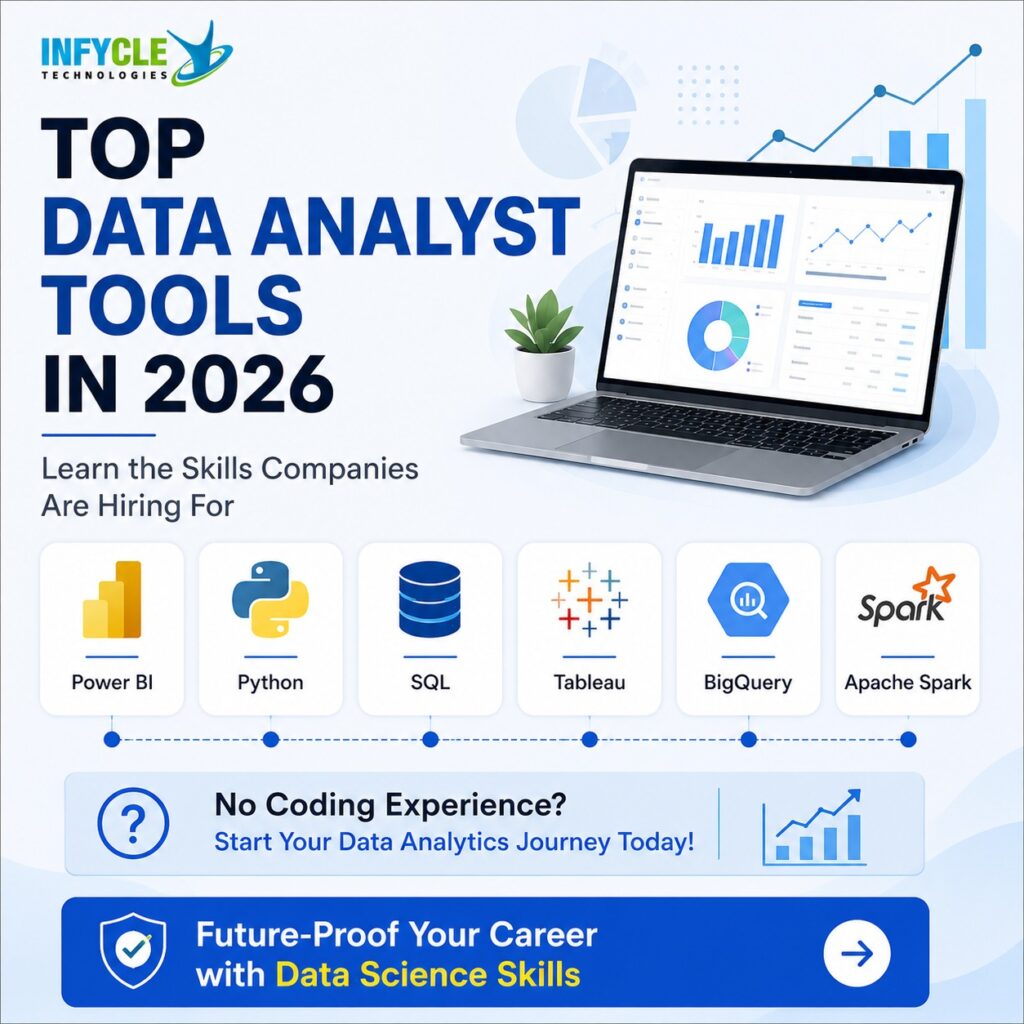
Top Tools Used by Data Analysts in 2026
Let’s explore the technologies shaping data analytics careers this year.
1. Microsoft Power BI
Power BI remains one of the most popular business intelligence platforms globally.
Companies use Power BI to convert raw data into interactive dashboards and visual reports. Its user-friendly interface makes it particularly attractive for beginners entering analytics careers.
Key Benefits:
- Interactive dashboards
- Real-time reporting
- Cloud integration
- Easy data visualization
- Strong enterprise adoption
Many employers now consider Power BI skills a core requirement for entry-level analyst roles.
2. Python
Python continues to dominate analytics, automation, and AI-driven projects.
Its simple syntax makes it accessible to beginners while offering advanced capabilities for experienced professionals. Python enables analysts to clean data, automate repetitive tasks, perform statistical analysis, and build machine learning models.
Popular Python libraries include:
- Pandas
- NumPy
- Matplotlib
- Scikit-learn
- Seaborn
Among all the Tools Used by Data Analysts, Python offers the greatest flexibility and long-term career growth potential.
3. SQL
Despite rapid technological advancements, SQL remains indispensable.
Organizations store vast amounts of business information in databases, and SQL allows analysts to retrieve, filter, and manipulate that data efficiently.
Common applications include:
- Customer analysis
- Sales reporting
- Financial tracking
- Inventory management
- Marketing analytics
Most data analyst job descriptions in 2026 continue to list SQL as a mandatory skill.
4. Tableau
Tableau remains a favorite among organizations seeking advanced data visualization capabilities.
Its drag-and-drop interface helps users create compelling visual stories without extensive programming knowledge.
Key strengths include:
- Interactive dashboards
- Visual storytelling
- Data blending
- Cloud connectivity
- Executive reporting
For professionals interested in business intelligence, Tableau remains one of the most effective Tools Used by Data Analysts today.
How AI Is Changing Data Analytics Tools
Artificial intelligence is no longer a future trend—it is actively reshaping analytics workflows.
Modern platforms now include:
- Automated insights
- Natural language queries
- Predictive forecasting
- Smart dashboard recommendations
- AI-assisted reporting
Tools such as Microsoft Copilot integrations, AI-powered analytics assistants, and automated reporting engines are reducing manual workloads while increasing productivity.
Analysts who understand both traditional reporting and AI-enhanced analytics are expected to have a significant advantage in the coming years.
If you’re planning to enter analytics from a non-technical background, focus first on SQL, Power BI, and Excel before moving into Python and machine learning concepts. A structured learning path often helps beginners build confidence faster and develop practical job-ready skills.
5. Microsoft Excel Still Matters
Many beginners assume Excel has become outdated.
The reality is quite different.
Excel remains one of the most widely used Tools Used by Data Analysts, especially for:
- Data cleaning
- Pivot tables
- Financial analysis
- Reporting
- Business forecasting
Even organizations using advanced analytics platforms continue to rely on Excel for day-to-day operations.
For students in CITY looking to start quickly, Excel remains an excellent foundation skill.
6. Google BigQuery
As businesses migrate to cloud environments, cloud-based analytics platforms are becoming increasingly important.
Google BigQuery allows organizations to analyze large datasets rapidly without managing complex infrastructure.
Benefits include:
- High-speed querying
- Cloud scalability
- AI integration
- Cost efficiency
- Enterprise-grade security
BigQuery is particularly valuable for analysts working with large-scale business data.
7. Apache Spark
Companies processing massive datasets often use Apache Spark.
Spark supports:
- Real-time analytics
- Machine learning
- Data engineering workflows
- Large-scale processing
While not required for every entry-level role, understanding Spark can help professionals pursue advanced analytics and big data careers.
What Skills Employers Want Alongside These Tools
Learning software alone is not enough.
Employers increasingly seek professionals who combine technical skills with business understanding.
Highly valued skills include:
Technical Skills
- SQL querying
- Data visualization
- Python programming
- Statistical analysis
- Dashboard development
Business Skills
- Problem-solving
- Communication
- Critical thinking
- Decision-making
- Presentation skills
The most successful analysts can explain complex findings in a way that business teams understand and act upon.
How Beginners Can Start Learning Analytics in 2026
Many aspiring professionals assume analytics requires a computer science degree.
That’s no longer true.
People from Commerce, Arts, Science, and Engineering backgrounds are successfully transitioning into analytics careers by following a practical learning approach:
- Learn Excel fundamentals.
- Master SQL basics.
- Understand Power BI or Tableau.
- Learn Python for analysis.
- Work on real-world projects.
- Build a professional portfolio.
This approach helps learners gain hands-on experience with the most important Tools Used by Data Analysts while developing confidence through practical application.
Why Analytics Careers Continue to Grow
Organizations increasingly depend on data-driven decision-making.
According to industry forecasts, analytics-related roles are expected to remain among the fastest-growing technology careers throughout the next decade.
Popular job roles include:
- Data Analyst
- Business Analyst
- Reporting Analyst
- Data Visualization Specialist
- Junior Data Scientist
- BI Developer
For job seekers looking for stable and future-focused opportunities, analytics offers strong career prospects across multiple industries.
Frequently Asked Questions
1. Which are the most important Tools Used by Data Analysts in 2026?
The most widely used tools include SQL, Python, Power BI, Tableau, Excel, Google BigQuery, and Apache Spark. These tools help analysts collect, process, visualize, and interpret business data.
2. Can non-technical students become data analysts?
Yes. Students from Arts, Commerce, Science, and Engineering backgrounds can enter analytics by learning practical skills, building projects, and gaining hands-on experience.
3. Is Python mandatory for data analyst jobs?
Not always. Many entry-level roles focus on SQL, Excel, and Power BI. However, Python can significantly improve career opportunities and salary potential.
4. Which tool should beginners learn first?
Most beginners should start with Excel and SQL before progressing to Power BI, Tableau, and Python.
5. Are analytics jobs expected to grow in the future?
Yes. Organizations across industries continue to increase investments in data-driven decision-making, creating strong demand for skilled analytics professionals.
Conclusion
The analytics industry in 2026 is powered by a combination of traditional reporting tools, cloud platforms, and AI-enhanced technologies. Professionals who build expertise in SQL, Power BI, Python, Tableau, and cloud analytics platforms will be better positioned for future career opportunities.
For aspiring professionals looking to build practical, industry-ready analytics skills, enrolling in a comprehensive Data Science Training in Chennai can provide the structured learning, hands-on projects, and career guidance needed to succeed in this competitive field.
If you’re searching for the Best Software Training in Chennai, Infycle Technologies offers practical learning approaches designed to help students, graduates, freelancers, and career changers develop in-demand analytics and technology skills with confidence.